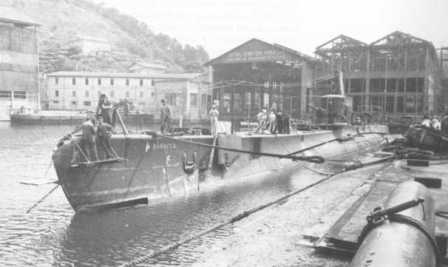
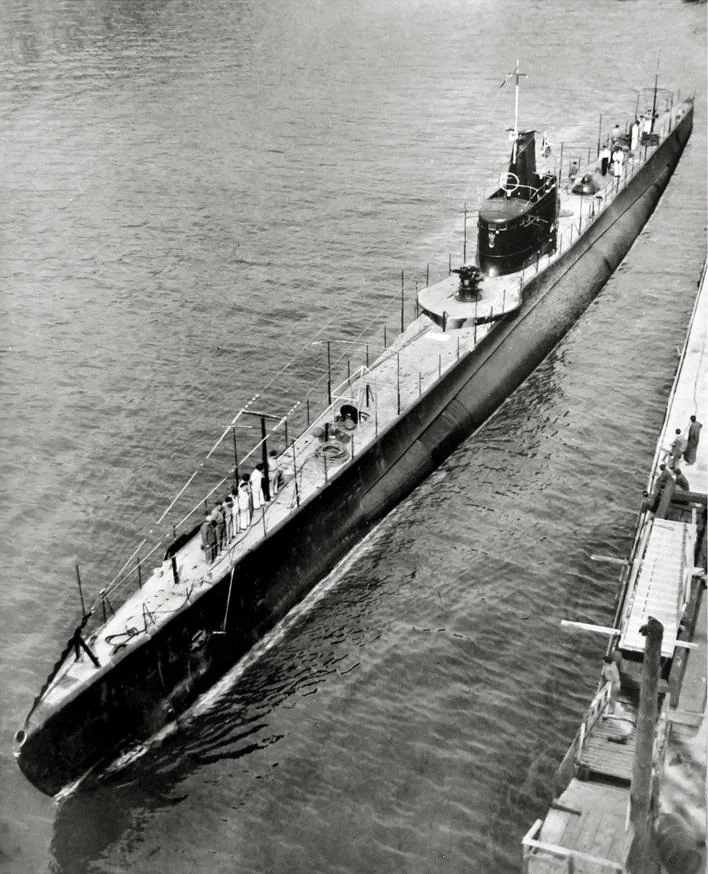
The submarine Baracca was one of the six boats of the Marconi class. It was named after Major Francesco Baracca, the world-famous Italian ace shot down over the Italian Alpine front during World War I and whose logo, a prancing horse, was later adopted by the carmaker Ferrari. Laid down in 1939 by the shipyard OTO of Muggiano, near La Spezia, the vessel was delivered to the Navy on July 10th, 1940, 20 days after the beginning of the war. After a very short period for the usual shake down, the boat was assigned to the newly established submarine base of Bordeaux. The boat transferred to the Atlantic along with eight other vessels, taking advantage of the new moon on September 2nd.
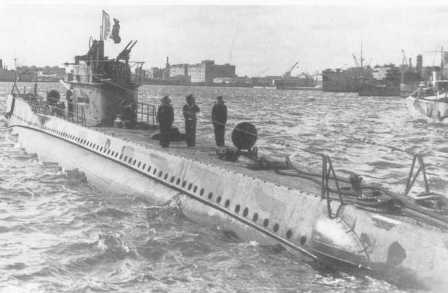
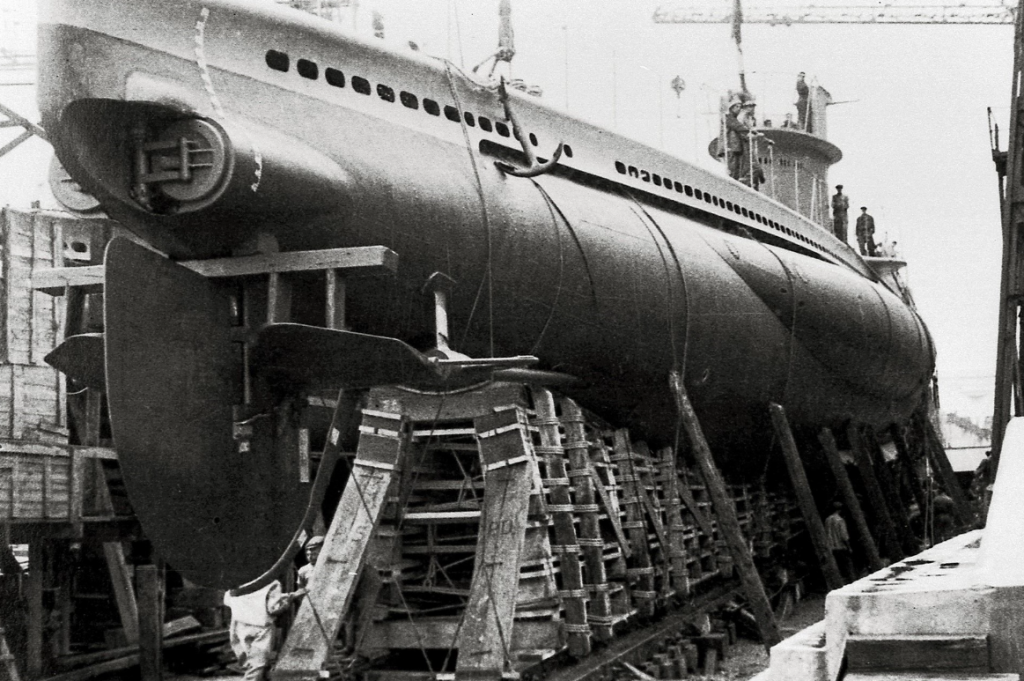
The submarine Maggiore Baracca at the Muggiano Shipyard during the last phase of construction before being delivered to the Regia Marina. (Photo Turrini)
Under the command of C.C. Enrico Bertarelli, the Baracca left La Spezia on August 31st reaching the Strait of Gibraltar a week later. As prescribed by the standing Italian procedures, the boat crossed the turbulent waters of the strait while submerged and without encountering any enemy activity. Completing the crossing, Captain Bertarelli moved west, reaching a previously assigned patrol area just off the Island of Madeira where it remained from the 12th to the 30th of September. During this period, the Baracca did not encounter any shipping, and at the end of the patrol the submarine sailed north to reach Bordeaux. While in transit, on October 1st the Baracca intercepted the Greek merchant ship Aghios Nicolaus of 3,687 t. The sinking took place in the afternoon, around 16:15 in position 40° N 16°55’ W. Captain Bertarelli gave the Greek crew time to abandon ship, and then sent it to the bottom with the deck gun; this was the beginning of the war, and chivalry was still in order. The Anghios Nicolaos was an old ship. Built in 1915 by the shipyard Napier & Miller Ltd, of Glasgow, it was previously known as the Ardargorn (1916), Australport (1924), Iron Age (1925) and Eugenia (1933). The vessel belonged to John C. Adamantios C. Hadjipateras, a shipowner based in Piraeus (Athens). Six days later, on October 6th, the Baracca reached its new base in Bordeaux.
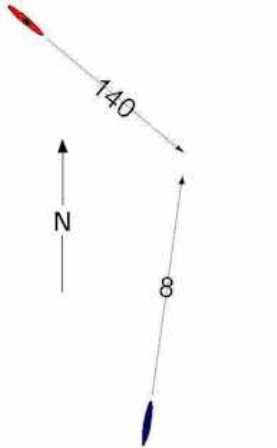
The period of rest in Bordeaux did not last long; the boat was new and required minimal maintenance. On the 24th of October, Betasom sent out the Baracca, along with the Bagnolini and the Finzi, on a mission coordinated with B.d.U, the German submarine command of Admiral Donitz. Once at sea, the Baracca moved north to reach the assigned patrol area situated west of the British Isles. Late on the 31st, the boat intercepted a merchant ship estimated around 1,500 t. Once daylight was gone and the darkness of the night had obscured the ocean, the Baracca launched a single torpedo toward the ship which was baldly attempting to ram the submarine. The ramming failed, and so did the torpedo and the two vessels moved away from each other with the Baracca capable of developing no more than 8 knots due to the dreadful weather conditions.
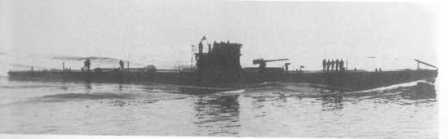
The Baracca in La Spezia (Photo Giorgio Parodi)
Soon after, on November 1st, the Baracca intercepted an enemy convoy composed of 4 or 5 ships and lacking escort. After sunset, Captain Bertarelli attempted several attacks, always failing to reach a suitable launching position. A few days later, on November 9th, and still facing terrible weather conditions, the Baracca attacked submerged a fast armed tanker which avoided the attack and ran away while the submarine could not catch up with it. Surface speed of the Italian submarine was relatively slow, and in bad weather its speed had to be reduced even more, making any pursuing almost impossible, unless it was a very old ship. A week later, on the 16th, the Baracca received a signal and, forcing its engines to the limits, attempted to make contact. Two days later, having exhausted its regular fuel reserve, it had to turn back and return to base. The same day, the 18th, the Baracca intercepted one of the isolated units of convoy SL 53 from Sierra Leone to Great Britain and immediately began a hard pursuit. For the record, this convoy left Freetown on October 27th, 1940 and was composed of 24 ships of which only one was lost, while another one was damaged. The remaining ships arrived in Liverpool on November 18th.
The merchant ship was the British Lilian Moller of 4,866 t.; two torpedoes launched by the Baracca decreed the end of this ship at around 17.00 on November 18th and none of the crewmembers survived the ordeal. The Lilian Moller went down in position 52° 57’ N, 18°’ 05’ W (note that some sources give the sinking in position 53° N -17° W). The Lilian Moller was also an old ship. Built in 1913 by the shipyard Sir James Laing & Son of Suderland, it was previously known as the Novgorod (1923), Cambrian Duchess (1931) and Valhall (1933). The vessel belonged to the Moller Line, a British shipping company based in Shanghai, China. Six days later, the Baracca reached base in Bordeaux. Considering the poor results of the first group of Italian submarines sent to North Atlantic, the success of the Baracca was considered positive, but the Italian command had to reflect over several serious issues. The design of the Italian boats did not make them very suitable for the rough sea. The deck gun was practically unusable, and torpedoes were easily diverted by the heavy swell. The engine air intake and the design of the Italian conning towers made things even worse by making life aboard these vessels very difficult.
1941
After the necessary refitting, the Baracca was again at sea and still under the command of C.C Bertani. In the new mission, the boat would lead a group which included the Morosini, Dandolo and the Otaria. The assignment was similar to the previous missions; the Italian boats, larger and with better endurance than the ones employed by the Germans, would patrol an area further west from the British Isles, while the U-boats and surface vessels would cover the area closer to the continent. The Baracca left port on January 19th, 1941 and on the 26th it reached its patrol area where, soon after, it sighted two enemy destroyers, another submarine, and a merchant ship it could not pursue. On the 4th of February, the Baracca was clearly sighted by a submarine hunter, but taking advantage of the sea fog it dived, eluding the dropping of about 10 depth charges which did not cause any damage. Bad weather continued and so did the lack of sighting. On February 12th, the boat began the return journey, reaching base empty-handed on February 18th.
Back to base, the Baracca underwent the usual refitting, but this time it was longer; the rough weather of the north Atlantic was taking a heavy tall on the machine. On April 10th, one day after the Dandolo, the boat left base for a mission in the more temperate waters off the Strait of Gibraltar. Even before having reached the assigned patrol area, the Baracca was the object of an aerial attack, followed by bombing from surface units. Between the 16th and the 19th the Baracca joined the Dandolo in an intense search for an enemy convoy, but on the 22nd the Dandolo, victim of serious breakdowns, had to return to base. The Baracca continued on, but having failed to intercept any convoy, it also returned to base reaching the banks of the River Gironde on May 4th.
Back to base, the boat was refitted while the crew experienced the usual period of rest. This time it would be short; the boat was back to sea on the 18th of June, leaving Bordeaux along with the Da Vinci. The operation, again to take place off Gibraltar, involved seven Italian boats. Of the seven boats, the Cappellini had to abandon mission due to mechanical failures, while the Bianchi was lost soon after departure, victim of HMS Tigris, a British submarine. The group chased four convoys failing to make contact. Three more convoys followed, but by then the Baracca had exhausted its fuel reserve and was already making it back to base. At the end of this mission, C.C. Bertarelli was transferred to the submarine school of Pola. Captains of his experience were needed to train a new generation of Italian submariners. Unfortunately, C.C. Bertarelli lost his life on January 30th, 1942 when the submarine Medusa was hit by one of the four torpedoes launched by the British submarine H.M.S. Thorn just off the Dalmatian coast in the Adriatic Sea.
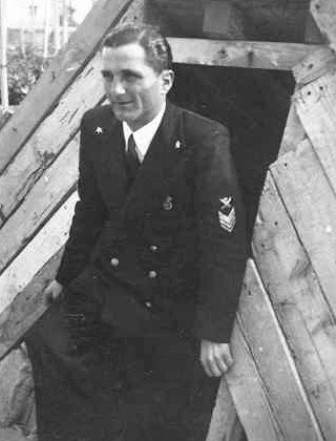
Chief 2° Class Renzo Del Bubba, one of the crew members lost with the sinking of the Baracca (Photo Rachele Granchi)
For the new mission in September the Baracca had a new skipper: T.V Giorgio Viani. Base was left on September 6th for another mission off the Strait of Gibraltar. The Baracca reached the assigned patrol area situated about 200 miles northeast of the Azores; it was September 7th. The same day the boat began the usual patrol, cruising up and down the assigned area. On the 8th, the British destroyer H.M.S. Croome sighted the Italian submarine, soon surrounding it with clusters of depth charges. Mortally wounded by the depth charges, the captain ordered the boat to the surface to fight to the end. The fight was one-sited; the Italian crew began scuttling the submarine.
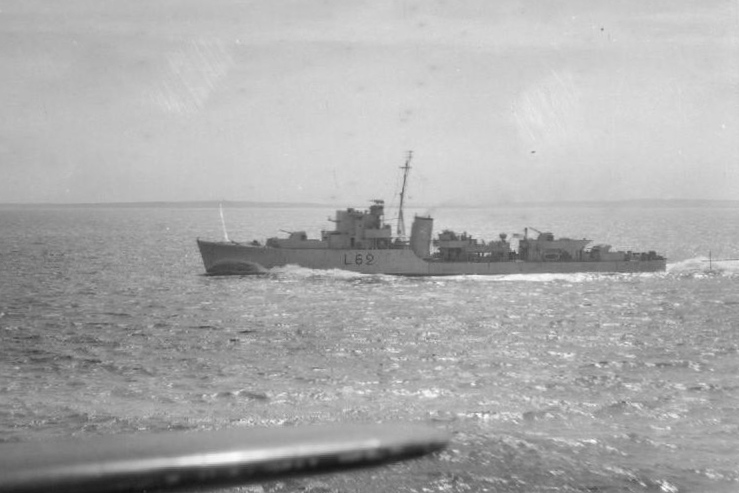
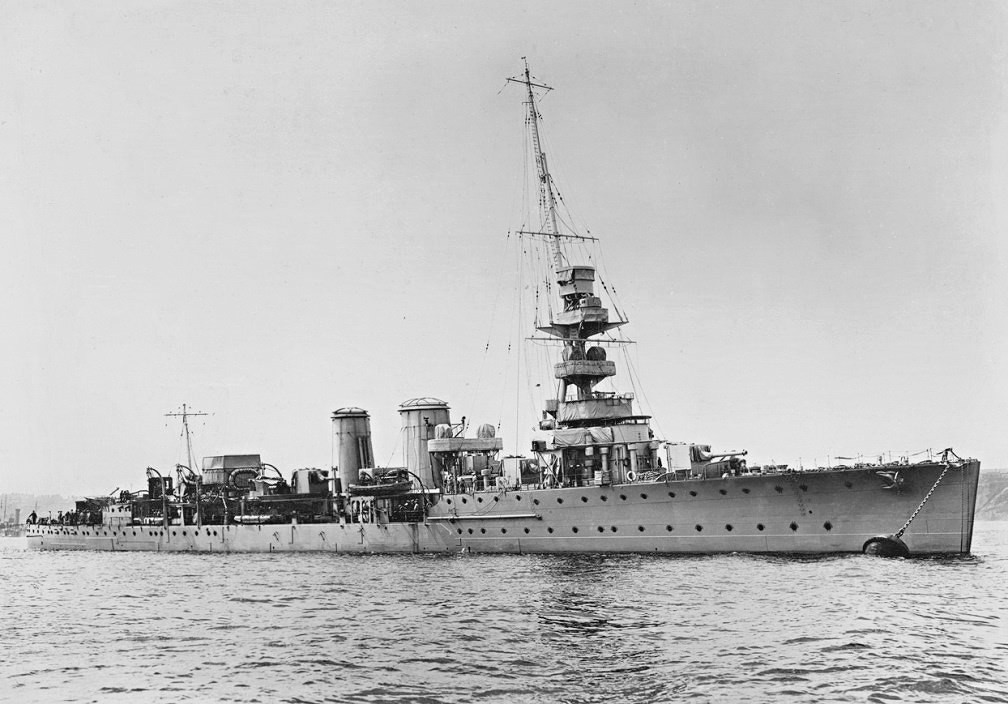
H.M.S. Croome
Thirty-two crewmembers were rescued in position 40°15’ N, 20°55’ W. Amongst the survivors, H.M.S. Croome captured the captain himself, T.V. Viani, the Staff Captain T.V. Piero Gherardelli, S.T.V. Pier Donato Poli and G.M. Ettore Gabetta. This was not the only painful loss of this period; the Malaspina was also lost, but in unknown circumstances. H.M.S. Croome was one of the latest destroyer escorts of the Hunt class, type 2. Built by the shipyard Stephen, the ship was commissioned on June 29th, 1941 with pennant L62. These were excellent boats displacing only 1,050 t. and armed with six 4’ guns and various antisubmarine armaments. The Croome survived the war to be sent for breaking up on August 13th, 1957.
The Alpino Bagnolini was not the most successful Italian submarine of World War II. Neither was it the one which sank the most ships. To the contrary, it only scored slightly more than 11,000 t. of ships sunk, and only if we also consider the Cabo Tortosa, a neutral Spanish cargo ship.
Still, the Bagnoli exemplifies the journey of the Italian submarine forces through most of the war. From the early success in the Mediterranean, to the various phases of the submarine campaigns in the Atlantic Ocean – North Atlantic, African Coast and later American Coast campaigns – to the fateful and last journey to Japan under a foreign flag and with a mixed crew carrying on their duties despite the downbeat turn the Atlantic campaign had already taken, it performed its duties. From “Happy Times” to “Sad Times” under the leadership of too many captains, the Bagnolini served faithfully, at times showing its design deficiencies but always taking the crew back to port but once, during its last fateful journey to Japan under the German flag.
Laid down on December 15th, 1938 in the Shipyard Tosi of Taranto, the Bagnolini, an ocean-going submarine of the Liuzzi class, was launched on October 28th of the following year and delivered to the Regia Marina on December 22nd, 1939. Just before the war, the boat was assigned to the 41st Squadron of the IV Group in Taranto.
Under the command of Lieutenant Commander Franco Tosoni Pittoni, the boat was part of a group of submarines assigned to a patrol area south of the Greek island of Crete just before the Italian declaration of war (June 10th, 1940). On the 12th, Captain Tosoni Pittoni was about 50 miles SE of the small island of Gavdo when, early in the morning, he sighted a destroyer squadron navigating at high speed which soon failed over the horizon. It was 10 minutes to 1:00 AM. A few minutes later, around 00:56 AM, two new vessels appeared in the periscope’s lenses. They were two cruisers of the Caledon class on a NW route navigating in line. Two minutes after the sighting, the Bagnolini ejected the first torpedo against the foremost unit, which was hit between the forward stack and the bridge. The hunt by the escort units began right away, thus the boat desisted from any further offensive maneuver and disengaged.
H.M.S. Calypso
The surviving cruiser was the H.M.S. Caledon, and its crew had to witness the sudden loss of the twin unit H.M.S. Calypso. The 4,118 t. light cruiser was lost in position 34°03′ N 24°05′ E. The Calypso, laid down on February 7th, 1916 and launched on January 17th, 1917 did not enter service until June 1917. After having served with the Home Fleet, the vessel was stationed to Alexandria as part of the Mediterranean Fleet. During the sinking, 1 officer and 38 ratings lost their lives. The remaining crewmembers were rescued.
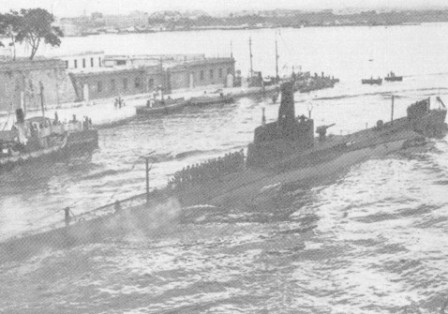
The Alpino BAGNOLI returning to Taranto after the sinking of H.M.S. Calypso in June 1940 (Photo Fraccaroli)
It was a brilliant beginning for the Italian submarine campaign in the Mediterranean, but a short lived one. Soon, successes dwindled and losses started mounting at an increasingly alarming rate. A second patrol followed from the 15th to the 24th of July in the same area, but this time without any success. Upon returning to base, the boat was sent to the yards for refitting in preparation for its transfer to the Atlantic Ocean.
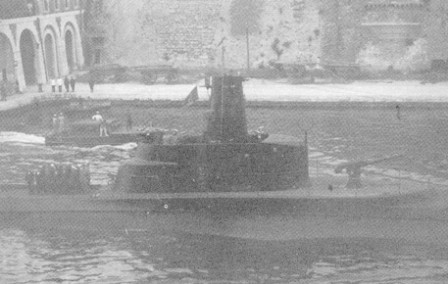
The Alpino BAGNOLI with the original and quite voluminous conning tower (Photo U.S.M.M.)
Along with other boats of the Liuzzi class, the Bagnolini left Trapani (Sicily) on September 9th, 1940 less than ten days after the Tarantini. The boat was part of a second transfer group, which also included the Marconi and Finzi. The crossing of the Strait of Gibraltar took place on the 13th, with surface navigation at night and submerged during daylight. Having completed the crossing, the submarine was stationed off Oporto (Portugal) for war patrol. Only a day after its arrival to the assigned area, the Bagnolini sank the Gabo Tortosa, a neutral ship flying the Spanish colors and belonging to the Ybarra & Compania of Seville. The sinking, in position 41° 20’ N and 9° 16 W, took over 90 minutes and did not cause any loss of life, but still was a regrettable incident. In fact, the Spanish vessel was signaled as having cargo destined for Great Britain, but it did not, as it was simply ferrying from Huelva to Bilbao. Lieutenant Commander Tosoni Pittoni was well intentioned to emerge and verify the identity and cargo of the ship, but smoke on the horizon forced him to make the critical decision to attack.
Towards the end of the patrol, on the 24th, the Bagnolini was attacked by a British airplane, which was repelled and, according to the crew, possibly damaged. Soon after, the boat continued on to its final destination reaching the newly established submarine base of Bordeaux on October 30th. Upon returning to base, Tosoni Pittoni escaped the scorn of Admiral Perona, the base commander, highly disappointed by the poor showing after the first sortie into the Atlantic. Perona, as he would many times, disapproved of the Italian captains’ lack of aggressivity, especially if compared to the German skippers.
The Submarine Alpino BAGNOLI in Bordeaux docket with the CAGNI following a heavy bombardment of the facilities (Photo courtesy Erminio Bagnasco and Achille Rastelli)
After almost a month in Bordeaux, on the 24th of October the Bagnolini was again at sea part of a large group of Italian submarines operating in coordination with their German allies. In all, 13 boats left for the North Atlantic and two, the Faa di Bruno and Tarantini, failed to return. The Bagnolini itself narrowly escaped disaster when, on the 28th, water entered the control room, badly damaging several systems. But let Captain Tosini Pittoni describe the ordeal:
After the necessary refitting, the Bagnoli was ready to rejoin the fight, part of a second wave of Italian submarines set off the Irish coast from December 1940 through February 1941. As before, there would be tragic losses, this time the Nani, while the Bagnoli once again narrowly avoided being lost. After having left on the 8th of December, the boat reached the patrol area 10 days later. On the 11th, the crew sighted the British cargo ship Amicus of 3,360 t., a straddle unit of convoy SC15 belonging to the Tempus Shipping Co. Built by Northumberland Shipbuilding Co. Ltd of Howen-on-Tyne in 1925, the boat went down in position 54° 10 N, 15° 50 W after a single torpedo hit it after sunset. The entire crew was rescued after the Italian boat had moved on. After having celebrate the New Year, January 1st at 7:20 PM in position 54° 13N, 13° 55’W, the crew sighted an aircraft when it was too close to attempt to escape by diving. It took 40 minutes for darkness to engulf the area and allow the boat to safely dive, but by then the British had already dispatched antisubmarine vessels that immediately gave chase.
The boat went down to 60 meters and established silent run. Inevitably, the chasers located the boat and the captain dove down to 80 meters, but he failed to fool the British. He dove again to 90 meters, and then the first salvo of depth charges came crashing down. A total of six charges exploded in proximity of the hull, causing the electric breakers to pop, the compass to fail, water leaks through the conning tower’s hatch and the torpedo-loading hatch. The loss of power caused the boat to dive even deeper reaching 130 meters. Fearing that all was lost, the captain gave order to blow the tanks and come to the surface and face the enemy. What followed was later described by Captain Tosoni Pittoni in his war report:
October 28th, 1940
“5:15 PM 160 miles from my assigned area, a wave out of sequence and sideways in relation to the main waves hit and engulfed the submarine and the men on the conning tower, pouring down into the control room and dragging away the second in command and the torpedo man guarding the foredeck.
The submarine slowed down under the weight and before it could reemerge from under the wave, it was hit by a second wave, which followed very closely the first one.
From the control room I ordered an increase in speed and also ordered to ready the second engine while exhausting the water which had entered the control room. Once on the conning tower, I ordered the rudder 20° to the side because I considered facing the waves too dangerous. I also ordered the personnel on deck below, along with the torpedo man who was stunned after the blow received, but during these actions we were hit by a third oncoming wave.
After a few seconds, having rescued the men on deck, I stopped the engine and closed the hatch ordering “dive” but at the same time the chief electrician manning the panels informed me that he could not power the electric motors because the solenoids were under water.
In the control room water had reached the lower part of the hatch and did not start pouring into the forward compartment (with danger to the batteries, compass, and converter), thanks to the prompt closure of the hatch. Nevertheless, water had invaded the motors and electrical panels located below the control room. To avoid ending up sideways to the main wave, I ordered the main hatch reopened and the diesel engine started. The boat went back along the wave as before. I took advantage of this time to expel water from the control room and verify the electrical motors’ control panels.
The serious deficiency in the operational efficiency of the boat caused by this incident forced the Bagnolini to return to base where it arrived on November 15th ( a source reports the 14th).
Note: The opening of the conning tower’s hatch was necessary because the intake valve for the diesel engines was located under the conning tower’s deck and had to be kept closed to avoid water entering, in great quantity the engine room and the ventilation system.”
The ordeal was not over. On the 3rd, on the way back to base, the Bagnolini was attacked by a British Bristol Blenheim airplane which dropped a few bombs, but missed the target. Three days later, on January 6th, 1941 the boat was finally back to base. The intense damage suffered during the mission forced the boat to the docks for repairs and refitting. Work began on January 20th, and was not completed until April 18th. During this period, Lieutenant Commander Tosoni Pittoni was transferred to the submarine Bianchi aboard which he lost his life, while another experienced officer, Lieutenant Commander Giulio Chialaberto, replaced him. Tosoni Pittoni later received the Gold Medal for bravery for the sinking of H.M.S. Calypso. During this period, the Italian command decided to transfer the Bagnolini to the German training base in Gotenhafen, but later the order was reversed and only the Giuliani reached the Baltic.
On July 10th, the Bagnolini was again at sea, this time assigned to a patrol area off Gibraltar in a newly attempted collaboration with the Germans. Lieutenant Commander Chialaberto took the boat east of the Strait to explore the area and scout for possible enemy traffic. On the 23rd, a large convoy of about 20 ships with 4 destroyers in escort was sighted in position 35° 45’ N, 14° 15’ W proceeding at 7 knots. According to the commanding officer, the Bagnolini was able to torpedo an 8,500 t. tanker and possibly a smaller cargo, but war records do not confirm these sinking. The Bagnolini had stumbled across convoy OG.68 from Liverpool to Gibraltar, which had left port July 12th with a total of 33 cargo ships, all of which made it to port on the 26th. A second convoy was sighted on the 29th and a signal broadcast, but the submarine was not able to take offensive action due to intense fog. On August 8th, the boat was sent back to Bordeaux where, once again, there was a change in command with Lieutenant Commander Chialamberto relinquishing command to Lieutenant Mario Tei. Chialamberto eventually would become the commanding officer of Maricosom in Taranto.
This time the refitting required several months of intense work and the vessel did not see action until early 1942. On January 18th, the Bagnolini left port and moved off the Azores Islands were it remained on patrol from the 23rd until February 10th. Having failed to intercept any traffic, the submarine returned to base arriving on February 22nd. Upon returning, the vessel was again sent to the yards where it remained for repairs and refitting until April 15th.
On April 24th, the boat left for a long mission to South America, not returning until June 28th. The operational orders, issued by Betasom in coordination with B.d.U., called for patrols off Cape San Rocco (Brazil) where it was assumed there would be intense traffic and minimal antisubmarine activity. Also part of this patrol was the Barbarigo and, during the famous attack of this boat under the command of Captain Grossi against a mistakenly identified California class battleship, the Bagnolini was only 70 miles away. Reaching the assigned patrol area on the 20th, the captain decided to move further south toward Port Natal, especially after having been sighted by two aircrafts. On the 21st, another aircraft spotted the submarine and soon after a destroyer or similar unit began a systematic chase which lasted for over 90 minutes. Later, as soon as the submarine had reached the surface, another aircraft, this time a Catalina, forced yet another crash-dive.
On May 12th, having sighted smoke on the horizon, the Bagnolini attempted an attack which had to be abandoned due to the presence in the area of an escort unit. Later the same day, there were two more sightings: first an airplane, and later a ship which soon faded from sight. Light escort units present in the area began giving chase dropping depth charges, but causing minimal damage, but having assessed that the two units were not to give up too easily, the captain moved the boat further south.
On May 26th, Betasom sent a signal ordering the boat off Pernabuco. The same day, at around 04:15 AM, the Bagnolini reported an isolated ship moving at about 12 knots, too fast for any offensive action. The night of the 27th, there was a real attack; this time with the launch of four torpedoes, one of which, according to the patrol report, was on target, but the tanker in question was able to move on, avoiding further attacks. There is no further information about this attack, but we know that the crew identified the large tanker as one of the type “Canadolite”.
Another signal from Betasom ordered the boat off Freetown, thus on May 31st Captain Tei began the transfer arriving in the new area a few days later. On June 7th it attempted to follow an isolated ship which, due to the poor weather conditions, was able to escape. Out of fuel, the Bagnoli began the return voyage, reaching Le Verdon the morning of June 28th. Of the 5 boats taking part in this operation (Da Vinci, Cappellini, Archimede, Barbarigo, and the Bagnolini), the Bagnolini was the only one which did not score a success. On the other hand, Captain Longanesi’s Da Vinci sank 19,997 tons of enemy shipping.
At the end of this long patrol, Lieutenant Tei, promoted to Lieutenant Commander, was transferred to the Giuliani while Commander Ferdinanto Corsi, formerly the captain of the destroyer Dardo, took command. On September 15th the boat was again at sea for a patrol off the African continent near the estuary of the Congo River. The night of September 28th, in position 19° 33N, 20° 06 W (about 300 miles north of Capo Verde), the lookouts sighted a ship with the navigation lights on, and soon after a destroyer, against which the skipper launched two torpedoes, missing the elusive target. Soon after, retaliation began with a long hunt and the launch of several depth charges that did not cause much damage. Orders from Betasom had the boat relocated south of Freetown and later on the route between Brazil and Sierra Leone. Without encountering any traffic, but sighting several planes and escort units, the submarine left the patrol area on October 26th reaching Bordeaux, along with the Archimede, on November 7th. Soon after, the captain disembarked leaving the Bagnolini in the hands of the new skipper, Lieutenant Angelo Amendolia. Of the four boats that had participated in this mission (Archimede, Barbarigo, Bagnolini, Cappellini) only Captain Saccardo’s Archimede was able to achieve any result, sinking a total of 20,043 tons of enemy shipping.
After a relatively small period for refitting, on February 14th the Bagnolini left La Pallice and was again on patrol and this time again assigned to the distant waters of the South American continent. The boat reached Brazil on March 8th, remaining until the 14th off Cearà and later until the 22nd off Cape S. Rocco. Immediately, the crew noticed an increased aerial activity that made the transfer tense and dangerous. Off the Canary Islands an aerial attack came close, but the boat did not register damages. Upon reaching the patrol area, it was noticed right away that there was very limited if any traffic, but a strong aerial surveillance.
The night of the 15th, just off the Island of Fernando De Noronha, a sudden airplane attack caused the forward portside fuel tank to rupture. With the boat already suffering from a previous water infiltration and limited fuel, on the 18th the boat began the return voyage. Two more sightings took place, on the 20th (a cargo ship) and the 22nd (a destroyer), but in neither case did the cinematic conditions favor an attack. This long and last mission under the Italian flag ended on April 13th with the arrival in France. As noted by the official Italian documentation, this mission did not produce any result, but helped demonstrate that the targets most preferred by the Italian submarines, isolated ships, had almost disappeared and aerial surveillance had increased dramatically, and had become quite efficient.
Following negotiations with the Germans, the Bagnolini was one of the seven submarines designated to be transformed into transports. Supposedly, the idea of transforming these vessels originated with C.V. Enzo Grossi, then commander of the base (Betasom), who had realized that these submarines were no longer fit for offensive operations. Grossi made a proposal to Adm. Donitz: in exchange for the 7 Italian submarines, the German Navy would transfer 7 newly constructed U-boats to the Italian Navy. Although it could appear that the proposal was preposterous, it was actually warmly welcomed, especially because the Germans were producing a boat a day, but did not have enough personnel to man them.
As part of the final agreement reached between the two navies, the Krigsmarine transferred seven U-boats of the class VII-c (designated by the Italians as class S) in exchange for an equivalent number of Italian boats which, due to their dimensions, were better suited for the long voyage to Japan. Of the seven vessels, only five began the refitting work. This operation was completely under German control, but the submarines were to retain their Italian crew. Of the five boats, the Tazzoli was lost soon after its departure, while the Barbarigo was lost probably soon after. Both losses were never documented and remain a mystery to these days. At the end of July 1943, both the Bagnolini and Finzi had completed the refitting necessary to transform the boat into transport submarines. Lieutenant Aldo Congedo took the boat from Bordeaux to Le Verdon at the estuary of the Gironde. The night of September 8th, having received news from Italy of the capitulation, the Germans kept the boat from leaving. The base commander, Captain Grossi, was ordered to destroy the remaining boats, but instead he had the Germans take them to the XII Flotilla pens where, still flying the Italian colors, the Bagnolini rested until the 14th. That day, following the Italian declaration of war on Germany, the tricolor was lowered, and the Italian crew disembarked.
The former Italian submarines were renamed “Aquila”, later changed to “Mercator”. The Bagnolini was renamed Mercator II, and later UIT-22. Under the command of Sub-lieutenant Wunderlish, the boat left Bordeaux on January 26th, 1944. The delay in departing was caused by the need for the German crew to master the Italian machinery, but with 12 Italians joining the Germans, safe operation was guaranteed.
The Submarine UIT-22 (formerly Alpino BAGNOLI) in Boardeaux (1943) (Photo courtesy Erminio Bagnasco and Achille Rastelli)
On February 22nd, 900 miles from Ascension, the boat was damaged by an American airplane, causing loss of fuel and forcing a mid ocean refueling by the U-178, at the time returning from Panang, off the South African coast. At the meeting point, 500 miles from Cape Town, U-178 found the ocean covered by a large amount of oil. On March 11th, UIT-22 (Bagnolini) had been sunk by three British Catalinas belonging to the 262nd Squadron. According to records made available only many years after the conflict, the South African squadron was sent to the attack area after detailed instructions about the rendezvous point had been deciphered by ENIGMA. The Bagnolini still rests at the bottom of the ocean.
The ARGO was one of the two submarines originally designed and built for the Portuguese Navy by the C.R.D.A. (Cantieri Riuniti dell’Adriatico) shipyard of Monfalcone, near Trieste. In that period, 1920s and 1930s, several foreign navies purchased submarines from Italian shipyards. These two boats (the other one was the VELELLA), were already in an advanced state of completion when, due to financial difficulties, Portugal had to renounce their construction.
Thus, in 1935, these boats were acquired by the Regia Marina, which completed their construction, making some alterations to the original design. The two boats, named VELELLA and ARGO, made up the ARGO class of coastal submarines. They turned out to be a good purchase since their design, slightly altered, would be utilized to build the famous TRITONE class from 1941 to 1943. The ARGO, although laid down since the early 1930s, was officially laid down in September 1935, when the Regia Marina took over the project. It was launched on November 26th, 1936 and delivered to the Navy on August 31st, 1937.
1940
At the beginning of the conflict, the ARGO was assigned to the 14Th Squadron, 1st Group based in La Spezia. From the 10th to the 11th of July, the boat was part of the screen of four submarines, which included the Iride, Scirè, and Diaspro, all positioned 15 miles apart. The ARGO, last boat of the screen, was ordered to a position 80 miles for 310° from the light of Point Asinara (Sardinia). Although during this patrol the ARGO was not able to sight any vessel, the Scirè, under the command of Liutenant Adriano Prini, sank the French ship Cheik of 1058 tons.
In August, the ARGO, still under the command of Lieutenant Alberto Crepas, completed a second patrol in the Mediterranean as part of a mission involving six other boats, the Scirè, Neghelli, Turchese, Medusa, Axum, and Diaspro. The Italian submarine command had ordered a screen on two lines (three and four boats each) north of Cape Bougaroni (6°20’E). The two lines were 10 miles apart and each submarine was positioned 20 miles from the next one. The second day into the mission, the Medusa had to return to base and was later replaced by the Manara. Despite the British Force H having crossed well past the position of the Italian screen, it had done so well north of the position where the submarines were located, thus there were two sightings. On the 8th, the mission was completed and the boats returned to base. The ARGO was to have more successful patrols in the Atlantic and later back in the Mediterranean.
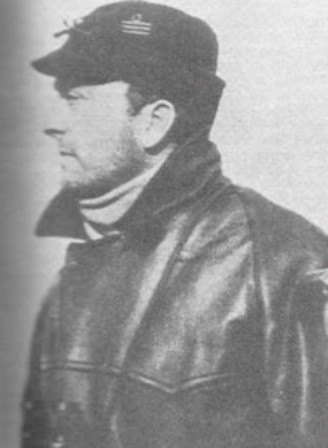
Lieutenant Alberto Crepas (Photo from ‘Cento sommergibili non sono tornati’ by Teucle Meneghini)
In September the ARGO was selected as one of the many submarines assigned to the newly established base in Bordeaux (France). The boat left La Spezia on October 2nd, 1940 and crossed the Strait of Gibraltar underwater on the 8th. While at sea, the ARGO was ordered to an area 50 miles off Cape S. Vincent. Here, the boat joined the TAZZOLI, located 80 miles away, to create a screen. On the 11th, the Tazzoli sighted a convoy and the ARGO was immediately called to the scene, but failed to locate the enemy ships. On the 12th, after having moved away, the ARGO sighted and attacked an armed merchant vessel of unknown nationality, which was able to first avoid the torpedoes, and then the shots from the deck gun. Failing the attack, the ARGO remained in the area between the 14th and the 19th, and as soon as it ran out of fuel, it moved on to Bordeaux, reaching the new base on October 24th. The ARGO was the 21st submarine to reach Bordeaux and the last of a group of nine.
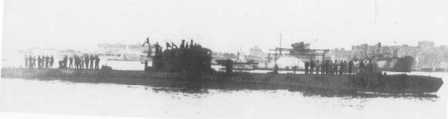
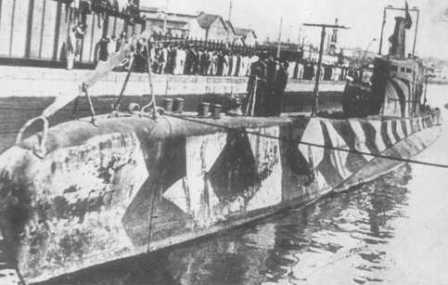
The ARGO upon its arrival in Bordeaux. (Photo courtesy Erminio Bagnasco and Achille Rastelli)
In November, the ARGO was part of the group “Giuliani”, along with the Giuliani, Tarantini and Torelli for a mission off the coast of Ireland. The group covered an area spanning from 15°W to 20°W and between 57°20’N and 53°20’N. German U-boats were instead located east of the Italian group. The ARGO left Bordeaux the evening of November 22nd and reached the assigned area six days later. At 04.49 on December 1st, Captain Crepas sighted a silhouette very low on the horizon. Concerned that it could be another Italian submarine, Captain Crepas sent a message with the on-board light. Once the ARGO was close enough, the unit was recognized as a two-stack destroyer and the attack commenced immediately. A single weapon (the Italians had a tendency to use only one weapon and this was often not sufficient in sinking the enemy vessel) was launched and it hit the target squarely. A second torpedo was also launched later on, giving the impression that the target was destroyed. Once back to the surface, the crew of the ARGO picked up numerous debris indicating the vessel in question as H.M.C.S. Sagueney (D79). Only 10 days later, the German submarine command (B.d.U.) received information that H.M.C.S. Saguenay, despite having been seriously damaged, had been towed back to England. After the war, the Royal Navy added that the destroyer was part of the escort for convoy HG.47 and that it had reached Barrow in Furness on December 5th (five days after the attack), confirming this information.
Lieutenant Crepas described the action as follows:
Copy of the war diary of the Argo.
The same night, having received a signal informing the ARGO of a convoy of 8 or 10 ships, the boat moves to the NE full force ahead, but capable of only 8 knots due to the heavy sea. In the early hours of the 2nd, the crew sighted flares, cannon shots and torpedo explosions. At 08.25 the ARGO sighted a small ship, stopped while picking up shipwrecked sailors, and launched a torpedo that failed right away, jumping out of the water. Immediately discovered, the submarine was the object of a prolonged hunt which lasted for over 5 hours and included the launch of 96 depth charges, some of which fell close to the hull. This was probably convoy HX.90 that had fallen victim to U 101, U 47 and U 99.
The ARGO continued on and on the 4th at 12.55 it sighted a Sunderland flying boat, which attempted an attack but was obstructed by the strong wind giving the submarine time to submerge. In the early hours of the 5th, the ARGO attacked and sank the British motorboat Silverpine of 5,066 tons, part of convoy OB.252 from Liverpool. This ship belonged to the Silver Line of London and was built in 1924 by Swan, Hunter & Wigham Richardson of Sunderland. The sinking took place in position 14°N, 18°08W and there were 36 casualties and 19 survivors. The Silverpine was a straggler of convoy OB252. After the attack, the ARGO was sighted by one of the escort units and, once again, it was forced in to an intense hunt lasting over 4 hours with the launch of 24 depth charges.
The following day, December 6th, the weather turned violent, causing the personnel on deck to be drenched under avalanches of water which entered the hull through one of the hatches, causing widespread damage to the equipment and the electrical system. Having ascertained the amount of damage suffered, Captain Crepas decided to return to base. In the afternoon of the 15th, with the tempest still tossing the small boat around, the second in command, Lieutenant Alessandro De Angelis, was thrown into the sea and the long and desperate attempt to save his life failed.
The tragic event is vividly described in Captain Crepas’ diary. Despite the heavy sea, he was able to drive the boat about 20 meters from De Angelis. A 23-year-old sailor, Chief Gunner Lorenzo Ciappetti, volunteered to dive into the boiling waters. The attempt was courageous but desperate and failed. Soon after, De Angelis’ head disappeared, never to be seen again. Somberly, the boat continued on, reaching Le Verdon near Bordeaux, on December 12th.
1941
After the usual period of rest and refitting, the second Atlantic patrol of the ARGO began on February 27th, 1941. The boat was part of the Group “Velella” which included the Velella, Emo, Mocenigo, and the Veniero. The units were positioned in a large area between 59°30’N and 53°N and between 13°W and 25°W. Again, the German U-boats would patrol the area closer to the Irish and Scottish coast while the Italians, with their larger submarines, would patrol further west. A few days into the patrol, the ARGO was victim of an unusual event. It was March 7th when a British Sunderland sighted the boat and correctly replied to the identification signal transmitted by the Italian crew. When the plane was 800 meters away and its identity could be ascertained, the crew responded to the threat with prompt and intense gunfire, forcing the plane to a loop and gaining enough time to dive.
Two days later, on the 9th, the ARGO was in the assigned area and briefly sighted a ship which then disappeared in the intense fog. On the 21st and 22nd, the ARGO moved in the area previously assigned to the Emo, but was not able to make any contact and returned to base, reaching Bordeaux on March 28th. The lack of contacts was not accidental; the British, having properly estimated the patrol lines set up by the Germans and Italians, had moved the convoys further to the north, assuming that bad weather and ice were better than torpedoes.
Following the decision made by B.d.U. on May 15th, 1941, the collaboration between Italian and German boats in the north Atlantic came to an end. It had taken months to recognize that the Italian vessels were not fitted for the harsh weather conditions and Italian participation in the wolf packs was not very successful. The Germans recognized the submarine Bianchi as one of the few valuable Italian boats.
Thus, in May 1941, the ARGO was assigned to a new patrol area west of the Strait of Gibraltar in coordination with the Mocenigo, Veniero, Marconi, Brin, Velella and Emo. The ARGO was assigned to the quarter closest to the Strait of Gibraltar, and after having left Bordeaux on May 19th, it reached the patrol area between the 25th and the 29th. Later on, Betasom ordered the boat to a new area, this time off Lisbon, well ahead of the convoy that was expected from Gibraltar heading north to England. On the 29th, Captain Crepas sighted a convoy, but then lost it. On the following day, the ARGO was attacked by light units near Cape S. Vincent. The 7th, the boat was ordered back to base and a day later it was attacked near Lisbon, registering some damage, but still able to make it home, arriving in Bordeaux on the 12th.
During this period, the Italian government wanted to return all submarines located in Bordeaux back to Italy. The issue was discussed at the highest levels, especially because Germany had only 30 submarines operational and needed the presence of the Italian boats. The German submarines were smaller and better suited for the Mediterranean, the Italian boats larger and more useful in the Atlantic. Still, Mussolini received permission from Hitler to withdraw the Italian submarines and on June 8th an order was issued in accordance. Soon after, on the 14th, Admiral Doenitz went to Berlin to request the reversal of this order. Admirals Reader, Weicholz, Riccardi and Parona were called to resolve a very difficult diplomatic and military situation. Finally, a compromise was reached; of the 27 Italian submarines still operating in the Atlantic, only 14 would be sent back. Eventually, due to war losses, only 10 submarines made the journey back, among them the ARGO (the other boats were the Dandolo, Veniero, Brin, Mocenigo, Velella, Emo, Otaria, Perla, and the Guglielmotti). The ARGO left La Pallice on October 11th and two days later was attacked by an airplane type Consolidated 31 that launched four bombs without hitting the target. On the 20th, the ARGO attempted the crossing of the Strait of Gibraltar on the surface, but was soon forced to proceed submerged. Four days later, on the 24th, the submarine arrived in Cagliari (Sardinia). Following this mission, Lieutenant Crepas was transferred, later assuming command of the large transport submarine Romolo, while Lieutenant Commander Giulio Contreas assumed command of the ARGO.
The ARGO in Cagliari after its return to the Mediterranean Sea. (Photo courtesy Erminio Bagnasco and Achille Rastelli)
1942
Upon its return to the Mediterranean, the ARGO was sent to the shipyard for a long period of refitting. It did not see service until spring 1942 when it began a long string of patrols, which lasted until the Italian armistice of September 8th, 1943. The missions were many, some short and some longer, some fruitless, but one in particular very successful. But let’s follow the chronology. From the 6th to the 21st of April, 1942 the ARGO was on patrol off Cape Ferrat. On the 10th, it sighted a cruiser but it was not able to reach a good position for the attack. Upon returning to base, Lieutenant Commander Contreas disembarked, replaced by Lieutenant Pasquale Gigli. The musical chairs, typical of the Italian submarine corps, continued. From May 22nd to the 29th the ARGO was assigned to a patrol area northwest of Cap Caxime (Algeria), where it was the object of three aerial attacks which caused considerable damage, forcing the boat back to base for an extensive period of refitting. In September, the ARGO was again at sea, this time for a patrol off the Balearic Island from the 15th to the 26th, followed by a patrol off the island of Galite (Tunisia) from the 29th to the 30th of October.
In November, a the submarine participated in a new patrol from the 7th to the 12th off the Gulf of Philippeville (Algeria). This time, a daring attack interrupted the monotonous routine of the patrol. On the 11th, the ARGO entered the Bay of Bougie where, undetected, it attacked and sank the British auxiliary cruiser Tynwald of 2,376 tons and the motorboat Awatea of 13,482 tons previously damaged by aerial attacks. H.M.S. Tynwald was an anti-aircraft ship, while Awatea was a troopship previously bombed by the Luftwaffe during operation Torch and abandoned 1 mile north of Bougie’s breakwater. Although belonging to the Union Steamship of New Zealand, the Awatea had been militarized. It was a modern steamship built in 1936 by the Vickers Armstrong shipyard at Barrow in Furness. After the successful attack, the ARGO returned to Cagliari on the 12th. A few days later, from the 17th to the 28th, it was again off the African coast, this time near Bona. After a brief period of refitting, the submarine was again in action on December 29th for the mission that lasted until January 8th, 1943. During this patrol, the crew of the ARGO sighted and attacked a group of ships against which it launched four torpedoes. A violent antisubmarine chase followed and there is no record of any damage to British ships on that date; it was the 7th of January.
1943
Other patrols followed, on February 20th off the Algerian coast, and on April 4th off Cap de Per. In April, Lieutenant Gigli disembarked, leaving the command of the ARGO to Lieutenant Arcangelo Ghiliberti. With the new command the routine did not change and from the 15th to the 20th of June the ARGO was again off Cap Carbon. Here, on the 19th, in position 36°54’N, 05°25E it launched a spread of four torpedoes against an enemy convoy. After the prescribed running time of about 4 minutes, the crew distinctively heard two explosions, but there is no record of this attack in the post-war British documentation. Immediately after the attack, the submarine was the object of an intense hunt.
From the 10th to the 12th of July, Captain Ghiliberti was ordered off the Sicilian coast. In the afternoon of the 11th, in position 37°02N, 15°28E the ARGO attacked a Southampton class cruiser and, after eight minutes from the launch of four torpedoes, it heard a clear explosion. Once again, it was immediately the object of an intense anti-submarine chase. On the 23rd of the same month, after having left Taranto for another mission off Sicily, the ARGO experienced serious mechanical trouble, forcing the boat back to port and then back to the shipyard of Monfalcone (northern Adriatic) for a long period of refitting.
The armistice of September 8th, 1943 surprised the vessel, still at the shipyard where the refitting was almost completed. The shipyard, located near Trieste, was under the military command of Captain Lorenzo Stallo. The shipyard was of great value since it was completing work on two new cruisers, the Etna and Vesuvio, plus the battleships Cavour and Impero were also there. Confusion was great and German troops soon occupied Trieste and later moved on Monfalcone. By September 10th, the whole area was under German control. In Monfalcone, the Regia Marina had a total of 16 submarines under construction and repair. Following the orders issued by the local commander, Rear-Admiral (E) Oreste Bambini, the ARGO was scuttled. It was an inglorious end to a boat that had faithfully served for many long years of war. The hull was later raised by the Germans and scrapped for metal. In all, the ARGO completed 31 patrols in the Mediterranean and 6 in the Atlantic, covering 31,524 miles on the surface and 2,550 underwater for a total of 245 days at sea. The ARGO was credited with a total of 20,924 tons of enemy ships sank.
Taranto March 5th, 1939 the launch of the Archimede (Istituto Luce B038607)
1940
At the beginning of the conflict, the submarine Archimede was assigned to the Italian naval base of Massawa, in Italian East Africa. The vessel, under the command of T.V. Signorini, was assigned to the first war patrol off the French colony of Djibouti. The boat left Massawa on June 19th to conduct the operation along with the costal submarine Perla. Even before the declaration of war, the vessel had experienced problems with the air conditioning system, and the assignment to this unscheduled mission caused repair work to be halted. With the mission underway, and within less than a day from departure, some of the crewmembers began experiencing illnesses; these would turn out to be similar to the ones experienced by the crews of the Perla and the Macallè. It is not known what the crew did to remedy the situation; perhaps they began using the air conditioning system less and less, but by the fourth day the apparatus had to be shut down. Several men, including two officers, experienced heat stokes, while in general more and more began showing symptoms of poisoning. Depression and loss of conscience were soon followed by loss of appetite, maniacal behaviors, euphoria, hallucinations, and finally a destructive and homicidal frenzy.
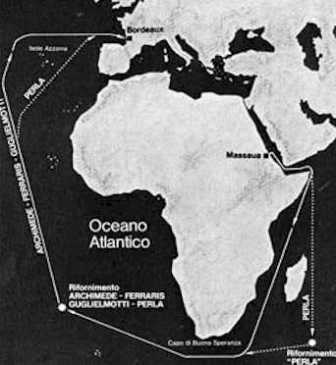
The long journey of the Italian submarines from East Africa to Bordeaux, France
In the late afternoon of the 23rd, the captain seriously considered aborting the mission when orders from the naval command moved the boat 50 miles further to the southeast. During the fatal night, four sailors lost their lives and the captain had no option but to seek refuge in the port of Assab where the vessel arrived at 8:30 AM on the 26th. Immediately after, Massaua sent the necessary replacements, including the captain and the chief engineer. The Archimede left Assab on the 3rd of July under the command of [C.C.] Lieutenant Commander Piomarta to return to Massaua where, finally, the methylchlorid (CH3Cl) was replaced with the much safer Freon. On August 31st, the vessel was once again ready to take to the sea.
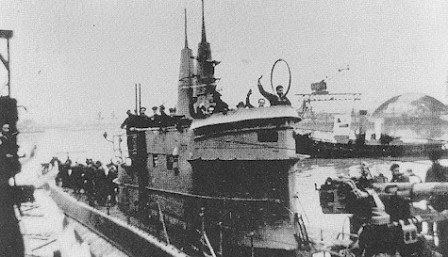
The Archimede upon its arrival in Bordeaux (Photo courtesy Erminio Bagnasco and Achille Rastelli)
During this period, Rome intercepted a British signal giving indication that a large convoy of 20 ships would be leaving Bombay to reach the Red Sea. Admiral Balsano, the commander of the Naval forces in Massaua, ordered all available units to sea, but the Archimede was not ready; this mission would be assigned to the Ferraris and the Guglielmotti. Opportunities for the Archimede came in September when the boat, along with the Guglielmotti and a group of destroyers, was assigned to patrol. During this mission the Archimede was assigned to an area between Gabel Tair and the 19th parallel north.
1941
As should have been expected, Italian East Africa (AOI) was quickly collapsing under the thrust of British forces from Kenya from the south and the Sudan from the north. Without any possibility to receive reinforcements from the motherland, the Italian forces where destined to surrender. Expecting the fall of the naval base, the local command began working on various escape plans. One called for the Archimede to reach Kobe, in Japan, and conduct offensive actions against the enemy traffic along the route. Eventually, only surface ships were sent to Japan, while the remaining submarines were sent around Africa to the submarine base of Bordeaux, in France. The Perla, a smaller unit, left on the 1st of March, the Ferraris and Archimede followed on the 3rd, and the Guglielmotti on the 4th.
Despite the loss of four boats, the morale of the submarine personnel in Italian East Africa remained good, but physical conditions were rapidly deteriorating due to the high temperatures and debilitating humidity. The submarines ordered to Bordeaux ventured south through the Gulf of Perim, a narrowing highly patrolled by British surface units and aircrafts. The Archimede (C.C. Salvatori), the Ferraris (C.C. Piomarta), the Guglielmotti (C.F. Spagone), and the little Perla (T.V. Napp) took different routes. The larger vessels navigated between Mozambique and Madagascar, while the Perla opted to take a route east of the island. The Archimede, as well as the other submarines, received diesel fuel from the German tanker Northmark and continued the long journey without any major incident. The transfer totaled over 12,700 miles of which only less than 65 were completed while submerged, and required 65 days. The mission was completed in the utmost secrecy, but once the boats reached Bordeaux, Italian newspapers gave great coverage to the event.
After several months in port for the necessary repairs and refitting, the Archimede was once again ready for action. Still under the command of C.C. Marino Salvatori, the boat was sent along with the Cappellini to patrol the Iberian coast, while other boats covered a relatively large sector between Gibraltar and the Azores Islands. This operation, which took the boat near Cape Finisterre and Cape San Vincenzo, did not produce results, mostly due to the complete absence of enemy shipping, but caused the loss of the Baracca , and the Malaspina.
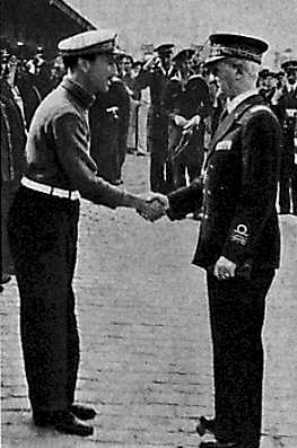
Admiral Parona, the head of Betasom, congratulates Commander Marino (photo U.S.M.M.)
Following this mission, the Archimede was ordered back to the Mediterranean. Still under C.C. Salvatori, the Archimede left Bordeaux and reached the Strait of Gibraltar where, on October 23rd, 1941 it was ordered to attack a convoy. Thereafter, the transfer order was rescinded, and the boat remained with Betasom for the remainder of its operational life. During this mission, the Archimede and the Marconi sought the convoy signaled by their command, and the latter was able to make contact on October 26th. Two days later the Marconi sent the last signal, and then all traces of the vessel were lost. Eventually, 48 hours later, the Archimede interrupted the search for this convoy and returned to base. Also lost during this mission was the submarine Ferraris, which had succumbed to the destroyer H.M.S. Lamerton after an unequal fight with the deck gun.
1942
After a long refitting period, the Archimede was transferred to the command of T.V. Gianfranco Gazzana Prioroggia, the Italian submarine commander who would achieve the greatest total tonnage sunk and second only to Carlo Fecia di Cossato for the total number of sinkings. The subsequent mission took the Archimede off the coast of Brazil. Departure took place between the end of April and the beginning of May, and the boat reached the assigned area on May 23rd; three days after the Bagnolini, the same day as the Cappellini and almost a week after the Barbarigo, which would be involved in the famous affair of the first mysterious sinking of an American battleship. During the transfer, on May 13th, the Archimede intercepted a signal from the Bagnolini north of Cereà (Brazil), but could not locate the vessel previously spotted. Upon reaching the final area, the Archimede intercepted in position 2º10’S, 35º55’’W a cargo ship ablaze escorted by surface units, thought to be destroyers of the “Maury” or “Somers” classes. In reality, it was the destroyer Moffett of the ‘Porter’ class. Captain Gazzana Priaroggia fired two torpedoes and heard two explosions, but it appears that the weapons never reached their target. Soon after, he was the object of a prolonged hunt. He wrote
As a result of these attacks, the Archimede began leaking diesel fuel from the hull, making it easy to spot. Betasom relocated the Archimede further north, where a new sighting could not be followed by a pursuit. Eventually, the boat used up all the fuel reserve available and began the return voyage, but on the 15th it intercepted and attacked the American ‘Colombian’, a ship of 4,954 tons, which avoided the torpedoes. The same day, the Archimede had intercepted and sunk another ship, the 5,586 t. Panamanian freighter ‘Cardina’. The ship was in service to the United States, and the U.S. Merchant Marine did not report any casualty. Continuing on, on June 27, while near the Azores, the Archimede intercepted a large convoy escorted by several surface units that could not be attacked due to the distance and direction of the ships. The boat returned to base in Bordeaux on July 4th after another long but not fruitless mission.
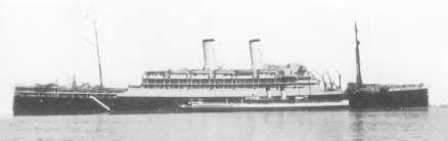
The following mission took place in the month of October. The Archimede, now under the command of T.V. Guido Saccardo, was tasked with refueling the Cappellini at sea, off the African coast. The boat left base on September 15th along with the Bagnolini. The original plan called for the vessel to reach Freetown, but B.d.U. had U-Boats already operating in the area, so Betasom was asked to delay its vessels. Due to great delay accumulated, the original plan to have the Archimede refuel the Bagnolini was abandoned and the vessel was freed to conduct offensive patrol. On October 8th, the boat reached a new area and the same day it intercepted the ‘Oronsay’, a large British passenger ship of 20,043 t. This ship belonged to the ‘Orient Steam Navigation Co, Ltd’ of London and was built in 1925 by the shipyard ‘John Brown & Co.’ of Clydebank. Capable of transporting 592 passengers, it was being used as a troopship. Of the people on board, 5 lost their lives, 26 were captured as P.O.W.s, and the remaining 412 survived. The sinking was given in position 4º 08’ N, 20º 57’ W by the Italian authorities, and 4º 29’ N, 20º 52’ W by the British.
Oronsay, the 20.043 t.s.l. liner sunk by the Archimede (Photo courtesy Erminio Bagnasco and Achille Rastelli)
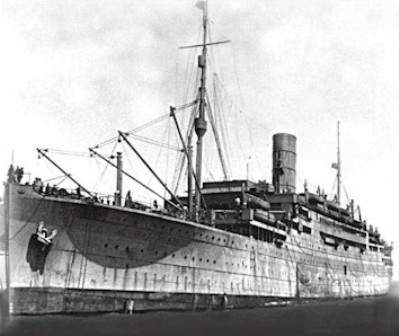
A few hours later, the Archimede attacked the 16,991 t. Greek passenger ship ‘T.S.S. Nea Hellas’, formerly known as the ‘Tuscania’, a British ship of the ‘Anchor Line” of London. This famous ship, affectionately known as the ‘Nelly Wallace’ by Allied troops, was in service to the Allies and was not returned to Greece until 1947.
It is not known if the Nea Hellas (New Greece) was hit by one of the torpedoes launched; it appears that it was, but eventually it was able to run away and avoid sinking. After continuing patrolling this area until the 19th, the Archimede was later repositioned south of the Capo Verde Islands, and area which it occupied until the end of the month. Having failed to intercept any traffic, it returned to base reaching Bordeaux on November 17th.
T.S.S. Nea Hellas
1943
The following and last mission took the vessel back to the waters off the Brazilian coast. The Archimede, still under the command of T.V. Guido Saccardo, left Le Verdon on February 26th, 1943 with general instructions to reach the area off Pernambuco, Brazil. The original operational plan called for the submarine to leave the area when the diesel fuel reserve was down to about 70 t., and then receive additional fuel from an Italian or German submarine. Eventually, with the extra fuel the boat would have been able to reach Rio de Janeiro, but the plan was called off. Instead of venturing south to the 23rd parallel, the Archimede remained north of the 20th. On the 10th of April the Archimede sent the last signal informing base of his position, given at 16º 45’S, 37º 30’ W, and also informing the Italian command that it had only 61 t. of diesel fuel left. At that point, the Archimede was given the coordinates for meeting a German submarine from which it would have received enough fuel to return to base. At 2:00 AM on the 15th, an airplane intercepted the Archimede, but due to technical difficulties of unspecified nature, the submarine could not submerge. The first plane, a spotter, called two more to the scene.
The sinking of the Archimede Documentation provided by Captain Jerry Mason, USN (Ret)
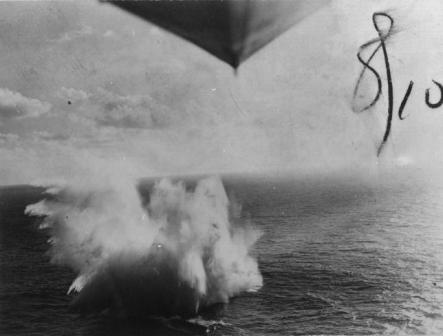
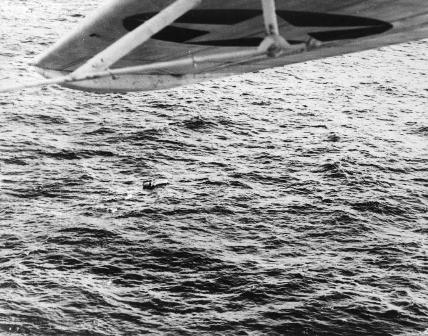
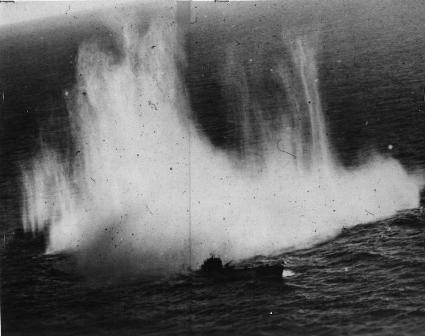
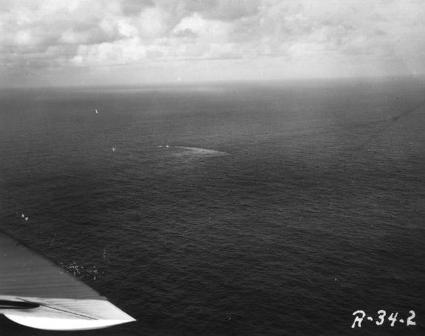
They were aircraft from the 93rd Patrol Squadron (They belonged to the U.S. Navy Patrol and were part of VP-83, which was also credited with the sinking of U-164 and U-507). The first aircraft , a PBY-5A Catalina piloted by Ensign T. E. Robertson, attacked in position 03°23’S, 30°28’W. Robertson made the first bomb run, dropping four depth charges from about 650 meters, and possibly damaged the boat. The second Catalina, piloted by Lieutenant G. Bradford, Jr., attacked minutes later, dropping four more depth charges from an altitude of 50 feet, which centered the vessel, breaking it into two sections which rapidly disappeared into the sea. About 20 crewmembers were able to survive and the American aircraft dropped three rubber craft. On May 27th, 27 days into an unimaginable ordeal, Brazilian fishermen found one of the original rubber crafts with three sailors; two already dead and one near expiring. After a long period of recovery, the only survivor, Giuseppe Lococo , was transferred to a POW camp in the United States. Only at the end of the conflict would Italian authorities receive detailed news of the loss of the Archimede and the terrible ordeal of its only survivor.
See the official U.S. Navy report of the interrogation proceeding of Giuseppe Lococo.
REPORT ON THE INTERROGATION OF PRESUMABLY SOLE SURVIVOR FROM ARCHIMEDE SUNK 15 APRIL 1943 26 July 1943
In reply refer to Initials and No. Op-16-Z
NAVY DEPARTMENT OFFICE OF THE CHIEF OF NAVAL OPERATIONS WASHINGTON
O.N.I. 250 – I/Serial 1
REPORT ON THE INTERROGATION OF PRESUMABLY SOLE SURVIVOR FROM ARCHIMEDE SUNK 15 APRIL 1943
26 July 1943
TABLE OF CONTENTS
Chapter
I. INTRODUCTORY REMARKS II. CREW OF ARCHIMEDE III. EARLY HISTORY OF ARCHIMEDE IV.WAR CRUISES OUT OF MASSAWA V.TRIP FROM MASSAWA TO BORDEAUX VI.EIGHTH WAR CRUISE VII.NINTH WAR CRUISE VIII.TENTH WAR CRUISE IX. ELEVENTH WAR CRUISE X.TWELFTH AND LAST WAR CRUISE XI.SINKING OF ARCHIMEDE XII.DETAILS OF ARCHIMEDE XIII.OTHER SUBMARINES XIV.SUBMARINE TACTICS XV.SUBMARINE BASES XVI. GERMAN SUPPLY SHHIP XVII. RELATIONS WITH GERMANS XVIII. MISCELLANEOUS
ANNEX A.
LIST OF CREW OF ARCHIMEDE
B.
LIST OF U.S. NAVY EQUIVALENTS
Chapter I. INTRODUCTORY REMARKS
The Italian submarine Archimede was sunk at 1625 P on 15 April, 1943 at 03° 23′ D., 30° 28′ W. by two U.S. Navy PBY-5A aircraft (83-P-5 and 83-P-12) based at Natal, Brazil. Thirty or 40 survivors were seen in the water after the attack; three rubber rafts were dropped near the survivors which were seen manning them. But, according to the sole prisoner of war from Archimede, only two rafts were successfully manned, one by 13 survivors and the other by six.
Apparently, on the 29th day after the sinking, one raft with a sole survivor washed ashore on the Island of Bailique near the western shore of the Amazon River. The survivor was found delirious and very weak by natives, who transported him to the nearby Island of Brigue. Some days after the prisoner had sufficiently recovered, it was discovered by the natives that he was Italian and a member of Archimede’s crew. The Brazilian naval authorities in Belem were notified of the survivor’s presence. The prisoner arrived in Belem 6 June, 1943, aboard a Brazilian gunboat. He was interned incommunicado at the Brazilian naval base, from which he was forwarded to the United States by air and arrived at an interrogation center 27 June, 1943.
It is pointed out that this report is based mainly on the story of one survivor and that its accuracy cannot be fully established. Unfortunately, no other Italian naval prisoner was available to test the sole survivor’s story. The prisoner did not appear at all security conscious. In fact he was anti-Fascist and loathed the Germans. He was a Sicilian, 26 years old, with only three years of elementary schooling. He was conscripted in 1939 and had
– 1 –
been four years in the submarine service. He appeared of about average intelligence but his memory with respect to dates and technical features of his submarine was limited — perhaps affected by his 29 days’ ordeal.
The prisoner and the aerial action reports both conform the certain destruction of Archimede. There has been no success in the search for other survivors, and it is believed that all the others perished at sea.
– 2 –
Chapter II. CREW OF ARCHIMEDE
According to the prisoner Archimede had a complement of 60 officers and men. Her commanding officer was Tenente di Vascello* Guido Saccardo, a Neapolitan, 29 years old. He was commissioned 10 January, 1936, and received his latest rank five years later. His first assignment was a torpedo boat. He served in the Spanish Civil War campaign. Since Italy’s entry into the present war he had served on destroyers; his last ship before volunteering for submarine service was the destroyer Lanciera, which was later sunk. On her he had been second in command and acted as fire control officer. But, he had told the prisoner, she had done nothing in the Mediterranean except escort a few convoys so that he had become disgusted with her inactivity. After a short course at the commander’s school at Pola he went overland to Bordeaux where he relieved Capitano di Corvetta Gianfrancesco Gazzana Priaroggia, a Milanese, of the command of Archimede in August or September 1942. According to the prisoner, Saccardo was a kind, easy-going officer and very well liked by his officers and crew, but there was considerable friction between him and Tenente di Vascello Zuliani, his Executive Officer. Saccardo was inexperienced in submarine service, gave orders poorly particularly with regard to torpedo firing and crash diving. The prisoner related that on the occasion of the sinking of Oronsay during the eleventh cruise, his commander caused the sub to plummet down about 40 metres at a diving angle of 45 degrees before bringing her under control. Then, at periscope depth, he missed the target with his first torpedo, so that Zuliani took over the
* For U.S.N. equivalents see Annex B.
– 3 –
firing of the next four torpedoes. Saccardo was very popular with his men because he had arranged for a refund of money charged his crew for double rations at the Bordeaux base. Immediately after the sinking of Archimede he encourage the survivors and kept them together. He appeared calm and resigned to his fate. The sinking, according to the prisoner, was attributed by Zuliani to the commander’s youth and inexperience.
The Executive Officer was Tenente di Vascello Zuliani from Padua. (O.N.I. Note: The only probable choice in the Italian Navy List is an Alberto Zuliani, Settetenente in the Reserve Port Captains’ Corps, commissioned 12 October, 1939.) He had joined Archimede at Bordeaux before her eleventh cruise. Previously he had been on a midget sub on the Black Sea. He supervised some of Achimede’s exercises outside of Bordeaux between her next to the last and final cruises. He was the first watch officer. The prisoner stated that Zuliani was extremely unpopular with the crew, effeminate, critical and cantankerous. He always wanted three or four orderlies to serve him coffee, cold cream, or pomade for his hair. He was the only officer who attempted stern discipline with the crew. While in a feverish condition after the sinking he was very critical of Saccardo’s ability and stated that the latter was entirely responsible for their disaster.
Capitano Direzione Macchine Lorenzo Ferrari, a Neopolitan, 33 years old, was the Chief Engineer Officer. He was evidently very capable and well liked. When the order to abandon ship was given, he held many of the crew below at the point of a gun and said, “If our sub sinks, we die with her”. According to the prisoner most of the 35 crew members who did not succeed in leaving the submarine were held below by Ferrari.
The gunnery officer was Sottotenente di Vascello Tommaso Magnani,
– 4 –
a Genoese, 30 years old, who was on the inactive list according to the Italian Navy List of November 1940. He had served in the Spanish Civil War campaign. The prisoner stated that Magnani had been a navigation officer in the Merchant Marine and that he had been drafted to submarine service in the late summer of 1942. He had, admittedly, no knowledge of gunnery. Still he was officer in charge of many gunnery exercises on Archimede between the next to the last and final cruises. The prisoner stated that Magani stood by with arms folded near the forward deck gun during the plane attack leading to the sinking. The ineffectiveness of the forward deck gun during this attack was ascribed by the prisoner to Magnani’s complete inexperience. He was quoted as having said, “I hope we submerged soon and get out of this mess”. He was popular, however, with both officers and men.
Sottotenente Direzione Macchine Bruno Miani of Trieste, 28 years old, was the first Assistant Engineer Officer. He was young and inexperienced; his first cruise was the last cruise of Archimede. The second Assistant Engineering Officer was another young officer who had also joined the boat on her last cruise — Sottotenente Direzione Macchine Boeschi, of Trieste He and the other three junior officers were very well liked by the crew.
Guardiamarina Franco (?) Greppi, a Genoese, Guardiamarina Alicata of Palermo, and Aspirante Sandri of Padua were the junior watch officers. They, too, had joined Archimede on her final cruise. Alicata had transferred from Cagni just before Archimede’s last cruise.
The prisoner stated that his boat had had five commanders during her life span. Saccardo had taken over from Tenente di Vascello Gazzana. (O.N.I. Note: According to Italian Press notices Gazzana was promoted to Capitano di Corvette in May 1943.) Gazzana made two cruises on Archimede —
– 5 –
the second and third cruises out of Bordeaux. According to the prisoner, the only success during these two cruises were two torpedo hits on an American cruiser of the Pensacola class and the sinking of an American ship of 6,000 tons. Prior to joining Archimede Gazzana had gone to the commanders’ school at Danzig for a three-months’ course. The prisoner considered him a good officer and a good commander. This opinion was shared by all the men. Gazzana, an ex-boxer, used to box with his men and playfully manhandle them. He was lenient with an efficient crew, but stern with a spiritless or sloppy crew.
While Archimede was awaiting orders to leave Massawa for Bordeaux, Capitano di Corvette Marino Salvatori arrived by air from Rome 10 days before her famous trip.* He took her successfully to Bordeaux and commanded her on her first war cruise out of the French port in September or October 1941. After this he returned to Rome where he was given a shore assignment in the Navy Ministry. The prisoner stated that Salvatori was a Count and as such received double pay. This extra pay he shared with his crew. Salvatori was popular with his men and was a good naval officer.
According to the prisoner, Tenente di Cascello Mario Signorini, who preceded Salvatori, was unqualified and much below the average naval officer. After her acceptance trials, Signorini was given command of Archimede and sailed her from Taranto to Massawa. Operating out of this East African base he made three peace time cruises and seven war cruises until the advent of Salvatori in March or April 1941.
The honor of first commanding officer at the commissioning of Archimede went to Capitano di Corvette Michele Asnasch, “a big paunchy Venetian”. He put the boat through her various trials and also took a short trip to Barcelona.
* see Chapter V.
– 6 –
He was popular, good natured and for his size quite agile. He was reputed to have considerable knowledge of submarines.
The prisoner was certain that Capitano Genio Navale Varoli was never on Archimede. (O.N.I. Note: Varoli is a prisoner from Tritone and stated that he had served under Gazzana on Archimede during most of 1942.) Tenente Genio Navale Alfio Di Bella made the trip from Massawa to Bordeaux as the engineer officer. He is now Capitano Genio Navale on the training ship Vespucci. Sottotenente di Vascello Leo Masina of Bologna was formerly navigation officer on Archimede. On the long trip to Bordeaux he acted as second in command under Salvatori. In January 1943, he left Bordeaux for a three months’ course at the commanders’ school in Pola.
According to the prisoner there was a fine family spirit on board Archimede; officers and men were very friendly except for Zuliani who attempted to be a severe disciplinarian. On the last cruise the crew included 25 new ratings freshly arrived from the Pola submarine school. The prisoner and 25 other ratings were veteran submarine men; but of these only five or six had made the trip from East Africa to France. The prisoner complained that there were constantly new ratings to instruct ashore and aboard.
The sole survivor, Giuseppe Lococo, was a Sottocapo Nostromo (Coxswain, 3cl.), who had been conscripted in 1938 and had been in submarine service since joining Archimede in January 1939. He described his duties as being a four hour daily watch on the conning tower, the operation of the horizontal rudder mechanism in the control room, and loading the forward deck gun. The prisoner called his boat “una carcassa” (an old hulk). In speaking of the commissioning exercises the prisoner expressed the wish that he had never had the honor of raising Archimede’s flag nor received a billet on her.
– 7 –
Chapter III. EARLY HISTORY OF ARCHIMEDE
The prisoner was very definite that the submarine sunk was not the “old” Archimede, 880 tons, launched in 1934 at Taranto. This boat, he said, had been sold to Spain in 1936. (O.N.I. Note: According to the 1941 edition of Jane’s Fighting Ships Archimede was believed lost in 1940. In ONI-202 of February 1943, it is listed as still operating.) The prisoner stated that his submarine was a “new” Archimede, 1.100 tons, built at the Cantiere Navale Franco Tosi, Taranto, during 1938. Her keel was laid early 1938, and after seven or eight months in building she was launched at the end of 1938. When the prisoner joined her in early January 1939, half of the crew had already arrived at Taranto. She was commissioned in the middle of January 1939, and the prisoner claimed that he had had the honor of raising her flag. Presiding at the commissioning exercises was Capitano di Fregata Remo Polacchini, second in command of the submarine base at Taranto. (O.N.I. Note: Brother of the well known Contrammiraglio Romolo Polacchini.)
Her trials were held outside of Taranto and consisted of crash diving, escape lung and torpedo firing exercises. These lasted 20 days; a few repairs were then necessary for the motors, pumps and valves. Capitano di Corvetta Michele Asnasch took over Archimede at her commissioning and was with her until Tenente di Vascello Mario Signorini arrived to sail her from Taranto to Massawa. She made a trip to Barcelona with the building yard’s engineers on board: here they held trials for seven days. Upon her return to Taranto more repairs and refittings which lasted one month were necessary. Following this, torpedo firing exercises were again held outside the port.
She refuelled and took on supplies for a trip to Massawa, her future
– 8 –
base. The builders sent an engineer to Africa to continue tests until the end of 1939 when the boat was officially consigned to the Italian Navy. She went from Taranto to Tobruk where she remained for two days. She then proceeded to Port Said remaining there one day. She arrived without incident at Massawa in the early summer of 1939, after a 15 days’ trip out of Taranto. Her hull was scraped in one of the two floating docks; this and a few internal repairs required 20 days.
At Massawa she went through torpedo firing and crash diving exercises and gunnery practice for a month. At that time she would crash dive to a depth of 15 meters in 36 seconds; later in the Atlantic she required 56 or 60 seconds to reach the same depth.
The first cruise out of Massawa started on 5 December, 1939. She set out with two or three other submarines, went to Assab, held exercises mostly crash diving outside the port for five or six days, and then returned to Massawa.
The second cruise out of Massawa was in January 1940. She again sailed down to Assab and held the same exercises as before. She was back in Massawa in 15 days, and the crew went ashore for two months to a rest camp near Asmara.
The third and last peace time cruise occurred in April 1940; she visited Port Sudan where the crew spent two days in port. After a cruise of eight days she returned to Massawa where she was put in a floating dock for repairs. One torpedo tube was leaking, and the crash diving tank which had been unsatisfactory was removed and a new one was installed. The prisoner said that the heat of the Red Sea was very hard on his boat and that it was necessary to clean her hull after every cruise.
– 9 –
Chapter IV. WAR CRUISES OUT OF MASSAWA
When Italy entered the war in June 1940, there were two submarine flotillas at Massawa, consisting of the submarines listed below:
1. Ferraris, Galelei, Archimede, and Torricelli.
2. Perla, Macalle, Galvani and Guglielmotti.
Archimede made seven war cruises out of Massawa all under the command of Tenente di Vascello Signorini. The prisoner stated that Capitano di Corvetta Livio Piomarta never made a cruise on Archimede out of Massawa. (O.N.I. Note: Piomarta commanded Archimede on one cruise out of Massawa, according to survivors of Ferraris; see C.B. 4093 (8), p.6)
FIRST WAR CRUISE
On the morning of 10 June, 1940, she was in the roadstead of Massawa harbor. She was ordered to leave immediately and to operate off the lower entrance of the Suez canal for 40 days. But she was out only 15 days because early one day they were sighted and attacked by six destroyers. She remained submerged for twenty-four hours during intermittent depth charge attacks. The air refrigerating tubes were broken; resultant gas killed six of the crew and temporarily crazed the others except the officers in the control room, who had shut its water tight doors. Ventilators also kept it free of gas. After all danger of further attack had passed, the officers surfaced the submarine and cleared the compartments of gas. The boat returned to Massawa where the crew was hospitalized for five months. They were then sent to a rest camp at Asmara for 15 days.
SECOND WAR CRUISE
This was a mission of seven days down to a zone off Perim. She
– 10 –
left Massawa on 20 December, 1940. The prisoner stated that “they sighted nothing and did nothing”.
THIRD, FOURTH, FIFTH, SIXTH AND SEVENTH WAR CRUISES
Each cruise was a routine patrol of five or six day’s duration. Again the prisoner stated that “they did nothing”.
– 11 –
Chapter V. TRIP FOM MASSAWA TO BORDEAUX
Archimede was one of the four submarines remaining out of the original eight when the war broke out. The other three were Perla, Ferraris, and Guglielmotti. According to the prisoner his boat was lying in the roadstead of Massawa at 0400, 2 or 3 April, 1941, when enemy gunfire was heard approaching the port from the direction of Asmara. Archimede under the command of Capitano di Corvetta Mario Salvadori and Guglielmotti, commanded by Capitano di Corvette Gino Spagone, were ordered to leave immediately for Bordeaux. Perla had left first about 2 March, 1941, and Ferraris about 20 days later. Before giving the order for the four submarines to depart the Italian Admiral of the base and Spagone, his second in command, had made arrangements for their refueling at sea. The prisoner stated that five or six days out of Massawa he heard a Rome radio broadcast acknowledge the British entry into Massawa 8 April, 1941. (O.N.I. Note: The prisoner’s dates are at variance with all previous reliable information. According to the Ferraris Report the four submarines left Massawa 3 March, 1941; Guglielmotti arrived at Bordeaux 5 May, 1941, Ferraris 8 May, 1941, and Perla 28 May, 1941. The Perla Report indicates her arrival as 20 May, 1941, another submarine’s arrival 6 May, 1941, and another 11 May, 1941. From press notices and other sources it appears certain that some of the four submarines from Massawa had arrived before 20 May, 1941, and all had reached their destination before 31 May, 1941.)
The prisoner said that his boat left in such a hurry that twelve of the crew were left behind in Massawa – one was a motor mechanic, the others were torpedo and electrical ratings. She sailed with a complement of thirty five including eight officers and eight petty officers. There were
– 12 –
on board, however, two passengers, a German merchant marine captain versed in Italian to assist in the refueling later, and on Italian Maresciallo Nocchiere (Warrant Quartermaster) aquatinted with the waters between Massawa and Bordeaux. Archimede and Guglielmotti travelled together on the surface for several days out of Massawa, submerging in the Red Sea only once or twice to test trim. Soon after their departure they met two convoys going in opposite directions. They fell in behind the south bound convoy and were undetected. They started through Bab el Mandeb at 2400 and were clear at 0400. At this point the two submarines parted. The prisoner said that Archimede passed Madagascar at a considerable distance but he did not know whether to the west or east of the island. After a trip of 45 or 46 days she arrived at the rendezvous 500 miles south of Madagascar to find Guglielmotti waiting half submerged but no sign of the supply ship. (O.N.I. Note: In view of the 45 or 46 days’ traveling and also the fact the only 30 days, according to the prisoner, were required after refueling to arrive at Bordeaux, the position given by the prisoner is very improbable. This rendezvous may have been the position of the second refueling of Perla, which 23 April, 1941, secured alongside a German oil tanker at 26° S., 18° W.) After making the proper recognition signals the two submarines pulled up close enough for the crews to converse. Archimede had practically exhausted her supply of provisions a day or two previously, and she had only 30 tons of fuel left. Her maximum fuel capacity was 200 tons, but at the beginning of her long voyage she had been able to get only 100 tons. Her commander facetiously suggested to the crew that with their enormous fuel supply of 30 tons they should take a run to Japan.
A short time before the supply ship* arrived, Ferraris also arrived
* See Chapter XVI for details.
– 13 –
on the scene. The prisoner was definite that Archimede refueled first, and was then followed by Guglielmotti and Ferraris. She finished refueling at 2400, 18 or 19 May, 1941, and immediately continued her journey. She took a course 300 miles south of the Cape of Good Hope. Thirty days later she arrived at Le Verdon at 0900, one hour after the arrival of Guglielmotti. Ferraris arrived 10 days later; she had been badly battered in the Bay of Biscay by a storm which had ripped off her after deck flooring. Perla came into Bordeaux a month later than the prisoner’s boat.
After their arrival at Bordeaux the entire crew was hospitalized for a month. They were then given one month’s leave plus 4 days for traveling. In Italy the crew was unfavorably impressed by the lack of attention or receptions which contracted with the great welcome and publicity they had received at Bordeaux. The prisoner returned to his boat in mid-August 1941. From her arrival until early September 1941, she was in Dry Dock No. 2 for repairs and refitting.
– 14 –
Chapter VI. EIGHTH WAR CRUISE
With Salvatori still as her commander, Archimede left Bordeaux for a forty days’ cruise 10 October, 1941, a few days before the departure of Ferraris. Both had the same operating zone off Gibraltar. She was near the scene of the sinking of Ferraris; they had arrived in the zone 21 October, 1941. At dawn 25 October, 1941, she sighted six enemy destroyers. She immediately submerged and soon heard the “pinging” of Asdic Search Gear on her hull. The destroyers depth-charged her from 0800 to 1300 and from 1400 to 2100. The prisoner heard 66 depth charge explosions. Her deck flooring was completely smashed, all lights were blown out, fuel tanks leaked, pumps were put out of order, the glass on instruments was demolished, manometers were crippled, and some torpedo tubes were leaking. Other than that the prisoner said that his boat survived the attacks very well! She continued to operate about 600 miles west of Gibraltar. Before the attack she had operated close to Gibraltar at night, but during the day she had remained a considerable distance away. She returned without any further incident to Bordeaux 17 November, 1941, for two months’ repairs. She was laid up in Dry Dock No. 1. The crew was given 22 days’ leave, at the end of which the prisoner with half of the crew was sent to an Italian rest camp near Bordeaux, where they had gun firing exercises and received instruction in their particular branches. Salvatori left Archimede and went to Rome for a shore job. Capitano di Corvetta Giuseppe Cardi, second in command of the base, assumed responsibility for the boat.
– 15 –
Chapter VII. NINTH WAR CRUISE
Tenente di Vascello Gianfrancesco Priaroggia, who had previously been Executive Officer under the famous Fecia di Cossato on Tazzoli, relieved Caridi in January 1942. The crew was all embarked 17 January, 1942. Gazzana took Archimede out immediately for twenty days. Cappellini and Finzi went out with her at the same time, but had different operating zones. Gazzaba’s mission was to report to the base at Bordeaux all ship movements out of Lisbon. At night she approached the coast at periscope depth to a point where the shore lights were visible. Five or six lighted ships of Spanish and Argentinean ownership were sighted leaving the port. On 6 February, 1942, she returned to Bordeaux. Two months of repairs followed during which the “old” 100.47 mm. forward gun was removed and a new 100.43 mm. gun was installed. The prisoner stated that Gazzana and twenty-five of the crew went to Danzig for training while the boat was being repaired.
– 16 –
Chapter VIII. TENTH WAR CRUISE
The prisoner was left ashore on this cruise. His estimates of its length varied from forty to sixty days. He believed that his boat with Gazzana still as commander left Bordeaux early May 1942. During this month the prisoner had fifteen days’ leave to visit his sick father in Palermo. While there he hears the Italian radio broadcast Gazzana’s claim of two torpedo hits on an American cruiser of the Pensacola class. (O.N.I. Note: No cruiser of this class was even in the Atlantic at this time.) At the end of May the prisoner was back in Bordeaux; twenty days later Archimede returned flying one small pennant for the sinking of an armed steamer of 6,000 tons. (O.N.I. Note: According to an Italian Bulletin of 25 June, 1942, this ship was sunk the day after the Pensacola action.) The prisoner was also told by crew members about the two torpedo hits on the American cruiser. Gazzana had not been able to see the results because he had been immediately attacked by destroyers, screening the cruiser, which had launched twenty-nine depth charges at the submerged submarine. Her electrical installations had been seriously disrupted, and there were also various internal damages. These necessitated over a month’s repairs. Gazzana left Archimede in August 1942. Tenente di Vascello Guido Saccardo had come from Naples overland to Bordeaux to relieve him. Saccardo had previously been in the Mediterranean on a destroyer. The crew remained ashore during Archimede’s repairs.
– 17 –
Chapter IX. ELEVENTH WAR CRUISE
Archimede left for a sixty day’s cruise approximately 11 September, 1942, with Saccardo as her commanding officer. Her mission was to operate in a triangular zone off Freetown described as follows: the base was along the equator from 13° W. to 22° W., the apex was at 09° N., 18° W., the two sides were the lines from the ends of the base to the apex. The prisoner claimed that, leaving Le Verdon, she followed a course as far as Cape Finistère and from Cape Finistère through the Canaries to her zone. Before reaching it she sighted only two Spanish ships. After cruising in her zone for a few days, she sighted Oronsay early 9 October, 1942. Saccardo fired the first torpedo and missed. Zuliani, his Executive Officer, took over and made a hit with the second torpedo. The prisoner stated that three more torpedoes were fired, one of them by a torpedo rating, Santalamazza, which actually sank the ship. The rating lost his diploma as expert torpedoman, because he had fired prematurely at the ready command. (O.N.I. Note: Oronsay was a British cargo and passenger ship, 20,043 tons, torpedoed without warning at 0515, 9 October, 1942, at estimated position 04° 29′ N., 20° 58′ W. She sank at 1815, after receiving three torpedo hits.) The prisoner stated that his boat took no other offensive action. She returned to her base between 11 and 20 November, 1942. Repairs in dry dock were necessary. The crew received a month’s leave, after which some had gunnery practice on a range outside of Bordeaux while others including the prisoner instructed new ratings from Pola aboard Archimede. The prisoner celebrated both Christmas and New Year’s Eve in Bordeaux by getting drunk.
– 18 –
Chapter X. TWELFTH AND LAST WAR CRUISE
The beginning of this cruise was marked by the advent of four new young officers and twenty five “green” ratings from Pola of whose training the prisoner had a low opinion. The prisoner stated that, before leaving, the crew was shrived and received communion from the same priest that was seen by Ferraris at the beginning of her last war cruise. The prisoner also said that the crew had a premonition of their impending fate for they bade farewell to the priest exclaiming: “We shall not see each other again, we are going to our death.” Together with Da Vinci and Bagnolini, Archimede left Bordeaux 14 February, 1943, for a four months’ cruise. Prisoner stated that his boat developed motor trouble before reaching Le Verdon and turned back. At 0500, 15 February she set out again preceded by a pilot vessel to Le Verdon. From this point a minesweeper about 100 meters ahead of her took up the van flanked by two German destroyers with planes overhead. The minesweeper exploded two mines near the entrance of the Grionde. The escort left Archimede after one day. It took her six days and nights to traverse the danger zone of the Bay of Biscay. During this period she travelled submerged from 0800 to 2000, from 2000 to 0800 she continued on the surface. Twenty five days out of Bordeaux she arrived in her operating zone. This was described as a tri-angle: one leg 500 miles long from Pernambuco to St. Paul Rocks, the second leg 300 miles in a line NW from St. Paul Rocks, and the base was formed by the line joining the two legs. Five or six days before arriving in her zone, one Argentinean and two Spanish ships were sighted. She entered the operating zone approximately 12 March, 1943. She patrolled the zone without sighting any enemy shipping. At 2400, 14 April, the prisoner saw plainly the lighthouse of San Fernando de Noronha. They continued on a course toward St. Paul Rocks.
– 19 –
While on patrol, stern torpedo tube No. 7 was found to be leaking badly, the torpedo was removed and the tube flooded.
– 20 –
Chapter XI. SINKING OF ARCHIMEDE
The prisoner’s story is at variance in a number of facts with the aerial reports so that it is considered advisable to submit both.
THE AERIAL ACTION REPORT.
An Italian submarine was sighted at 1510 P, April, 1943, by a U.S. Navy PBY-5A (83-P-5) of Squadron VP-83 based on Natal, Brazil. The weather was good, visibility varied from 10 miles to unlimited at an altitude of 7,300 feet. The submarine was fully surfaced and was sighted dead ahead at a range of 8 miles and on opposite course making 5/7 knots. The plane pilot held his course and altitude to a point about aft of the submarine. About that time the latter opened machine gun fire. The plane made a gradual turn to starboard and lost about 1,000 feet altitude. The pilot decided to make a horizontal bombing run at 6,000 feet and drop from his starboard wing two Mark-44 bombs carrying Mark-19 nose fuzes. Gunfire from the enemy boat had not ceased. At an altitude of 6,000 feet and at a range of about one half mile, it appeared that the submarine was about to submerge. The plane immediately dove at an angle of about 60° and at about 2,000 feet released all 4 bombs including 2 Mark-44 bombs on the port wing equipped only with hydrostatic fuzes set for a 25 foot depth.
The bombs from the starboard wing were seen to explode close aboard and to port of the boat about 20 feet abaft the conning tower. Those from the port wing exploded to starboard about 60 feet forward of the conning tower. The enemy continued to fire back throughout the run. Water thrown up by the explosions completely hid the submarine. When the water subsided, she was seen on the surface circling and apparently unable to go to starboard, and leaving a long streak of brown oil. Much dark grey smoke was coming
– 21 –
directly from and aft of the conning tower; she appeared out of control doing 4/5 knots. About 15 or 20 minutes later the smoke cleared and she resumed a straight course bearing 065° – 080° T. Keeping her in sight the pilot climbed to about 6,000 feet and radioed to nearby planes for assistance. While the plane was circling around 6 miles away, puffs of smoke were observed from the enemy’s forward deck gun – 10 rounds during 40 minutes before the arrival of a second plane.
Forty-five minutes after the first attack another PBY-5A (83-P-12) of the same squadron arrived on the scene. It had received a signal from the first plane and proceeded to the location indicated. Flying at 1,500 feet it sighted the submarine at a range of eight miles, fully surfaced but down at the stern with her after deck awash. Direct attack would have been beam on, but the plane flew around to the stern for a 180° target angle. The boat altered course to port during the plane’s run, thus making a target angle of 210° at the instant of bomb release. At about 1,500 yards both plane and submarine opened fire, the enemy gun on the aft end of the conning tower firing about two rounds per second. In this first run the plane dropped a load of four bombs from an altitude of 50/100 feet; they were Mark-44 depth bombs set for sixty-five foot spacing and twenty-five foot depth. Explosions were observed along the port quarter and probably bracketed the hull just aft of the conning tower, the fourth on the starboard deck just aft of the conning tower. The same plane made four more runs circling to starboard. The submarine and plane exchanged gunfire during the bombing attack and the four subsequent strafing attacks.
The first plane combined with the second plane in two of the four strafing runs. She also made a third strafing run alone, during which the
– 22 –
boat’s bow was sticking out of the water at an angle of about 50°. Following the explosions caused by the bombs of the second plane the submarine settled gradually by its stern and the bow came up out of the water until it protruded at an angle of about 50°. She slid slowly down and backwards until completely under the surface. She sank at 1625 P, about 6 minutes after the last mentioned explosions. A considerable quantity of heavy brown oil appeared on the surface forming a 25′ x 200′ semi-circle over the spot of the sinking. One large burst of bubbles appeared as the bow slid under. There was no debris but approximately 30 or 40 survivors were in the water, one-third of whom appeared to be wearing Kapok life preservers or escape lungs.
The enemy exchanged gunfire during all the bombing and strafing runs of both planes. In fact, the gunner on the aft conning tower machine gun did not cease firing until the tower slid beneath the surface. The second plane observed many hits on and around the conning tower from its bow gun. This plane made two runs after the sinking, and dropped one 7-man rubber raft on each run close to the survivors. The first plane also made a run after the sinking to drop one 7-man rubber raft near the survivors. Following her initial bombing attack the first plane remained in the area almost two hours. At the end of the operation the survivors were seen manning the life rafts dropped. A plane searched in vain on the following day for the survivors.
The forward deck gun and the 37 mm. mounted machine gun on the aft part of the conning tower were ineffective, but a 50 calibre machine gun on top of the tower was more accurate and made 3 hits on one plane. The aft deck gun may have been blown off by explosions.
THE PRISONER’S STORY.
There was some clouds in the sky and the sun was low on the horizon
– 23 –
when the first attacking plane appeared. The prisoner was in the aft torpedo compartment at 2000 on 15 April, 1943, when he heard the Executive Officer announce over the loudspeaker: “Plane sighted dead ahead.” Immediately Saccardo gave orders to man the guns and to secure all watertight doors. The prisoner ran to his post at the forward deck gun. Magani stood by with his arms folded and giving no orders but expressing the hope that the order to submerge would soon be given. All on deck were surprised that the first plane made an initial run over their boat without dropping any bombs. The submarine began evasive tactics but made no attempt to submerge. From a point aft of her the plane turned back for a run over the boat. It dropped two bombs, both missed but one dropped close to the forward starboard side. The concussion from the explosion was terrific, the outer and inner hatches of the forward hatchway were ripped open and away from their hinges, and a mountainous wall of water covered the entire boat. In fact, many of the survivors were sick from the quantity of sea water they swallowed during this cascade.
Because of the damage to the forward hatches Archimede was unable to submerge. The lighting installations had been smashed and one Diesel engine had been rendered inoperative. She continued on the surface following an evasive course. The plane in the meanwhile kept circling at a distance. The prisoner claimed that her guns did not fire during the attack nor before the appearance of the second plane. Fifteen minutes elapsed between the first and second attacks.
Suddenly out of a cloud about 1,000 meters away, a second plane appeared and made a run at low altitude over the submarine. It dropped two bombs which hit the pressure hull aft of the conning tower. One tore through the aft hatchway, and a sheet of flame burst from the oil deposit at the bottom of the hatchway. The four primed torpedoes in the aft tubes also exploded.
– 24 –
The explosions ripped a tremendous hole in the pressure hull, and the aft torpedo compartment hung like “a broken arm” from the rest of the boat. She plunged stern first beneath the surface with her bow high in the air. The prisoner was peppered by many small metal fragments in the second bomb attack. The Engineer Officer at the point of a gun held many of the crew below. Twenty-five including the Commanding Officer succeeded in getting into the water free of the sinking submarine, but of these six were drowned either because of wounds or burns from flaming oil. The machine gun on the port side of the aft conning tower had been rendered useless during the first bombing attack, but the starboard machine gun manned by Sottocapo Motorista Votero continued to fire until the water reached his neck. He was badly wounded in one leg and died shortly after he was pulled aboard a raft. The prisoner protested that the first plane machine-gunned those in the water before dropping a rubber raft.
Three rubber rafts were dropped by the planes but only two were recovered. The prisoner swam about 100 meters to recover them. He inflated them, tied one in tow and rowed to the other survivors. One raft was manned by thirteen including the Captain, the Executive Officer, two junior officers (Creppi and Magnani) and the prisoner. In the other there were six ratings. The two rafts tied up together and drifted as the occupants were too weak to row. The prisoner stated that according to Greppi they were drifting toward the Antilles. On the day after the sinking as well as on the following day planes were seen circling around at a distance. Some of the survivors stood up and blew little whistles furnished in the rafts. They had practically no clothing for signaling. But they were never sighted. On the fifth day adrift, a steamer was sighted on the horizon but again no success attended their attempts to signal her attention. Again on the seventh day a steamer
– 25 –
which Saccardo believed to be Argentinean, passed about 1,200 meters away at approximately 10 knots. Saccardo then transferred to the raft with six men, borrowed 2 oars from the first raft and set off in the direction of the ship. He promised to return for the remaining twelve survivors if he were successful. Nothing was seen or heard of the Commander and his companions after that. The prisoner doubted that Saccardo ever succeeded in reaching the ship. The prisoner’s raft drifted on; the survivors one by one except for the prisoner died either from wounds, burns, hunger, thirst or from drinking too much sea water. Zuliani died two or three days before the rescue of the sole survivor. Only an occasional brief rain squall interrupted the intense heat of the day. The prisoner had a narrow escape on the twenty-eighth day adrift; the raft overturned throwing him into the water but the next wave righted the raft and threw him back into the raft. This incident reminded the prisoner that Zuliani before dying had assured him that he would be the sole survivor. On the twenty-ninth day after the sinking the raft washed ashore on the Island of Bailique near the Western shore of the Amazon River; the prisoner was found weak and delirious by two Brazilian fishermen.
– 26 –
Chapter XII. DETAILS OF ARCHIMEDE
DISPLACEMENT.
According to the prisoner 1,100 tons on the surface and 1,200 tons submerged.
LENGTH.
75 metres.
WIDTH OF PRESSURE HULL AMIDSHIPS.
4 metres.
HEIGHT OF PRESSURE HULL.
Between 4 and 5 metres.
HEIGHT OF PRESSURE HULL AND TANKS.
Between 5 and 6 metres.
EXTREME WIDTH OF PRESSURE HULL AND SADDLE TANKS.
Between 6 and 7 metres.
HEIGHT OF CONTROL ROOM.
2.65 metres.
HEIGHT OF CONNING TOWER FROM DECK.
Between 2 and 3 metres.
WIDTH OF PLATFORM ON CONNING TOWER.
2 metres.
LENGTH OF PLATFORM.
5 meters.
– 27 –
WIDTH OF DECK PLATFORM.
3 metres.
DRAFT AMIDSHIPS.
4 metres.
BOW.
Raked and rounded on top.
TYPE.
According to the prisoner improved Archimede Class.
DEVICE.
On the port side of the gray-colored conning tower one of the crew had painted a white dolphin.
LAYOUT (FROM BOW TO STERN).
Forward Torpedo Compartment.
Hammocks for ratings.
Watertight bulkhead and escape chamber.
Communications Room.
Petty Officers’ Quarters forward, port and starboard.
Hydrophone booth forward starboard.
Wooden partition.
Captain’s enclosure aft starboard.
Officer’s Quarters starboard.
Radio Cabin and Water Closet aft port.
Watertight bulkhead.
Control Room. Munitions magazine under floor plating aft of periscopes.
Watertight bulkhead.
Engine Room.
Diesels.
Watertight bulkhead.
– 28 –
Auxiliary Compartment.
Electric motors and galley.
Watertight bulkhead and escape chamber.
Aft Torpedo Compartment.
Hammocks for ratings.
TORPEDO TUBES.
Eight 21″ tubes, 4 forward and 4 aft. The two aft upper tubes were numbered 1 (starboard) 2 (port); the two aft lower were 3 (starboard) 4 (port). Forward the upper tubes were 5 (starboard) and 6 (port); the lower 7 (starboard) and 8 (port). The tubes were checked every 7 or 8 days for water leaks. No splashless-discharge “senza bella” apparatus was fitted. All tubes were loaded with primed torpedoes on war cruises.
TORPEDOES.
She carried ten 533 mm Naples torpedoes, six electric and four magnetic, and six 450 mm Fiume air torpedoes. All the former type were marked “Silurificio di Napoli”. There were eight reserve torpedoes, four in each torpedo compartment kept under the plating, two port ad two starboard. Two Naples electric torpedoes and six Fiume were carried aft and eight Naples including the magnetic were carried forward. The maximum range of the Naples type was 8,000 metres, that of the Fiume type was 6,000 metres; at the end of their maximum run the unexploded torpedoes sank. The Naples type was seven metres long with an explosive load of 250 kilos of trinotrotoluol while the Fiume torpedo was six metres long with an explosive load of 150 kilos. The smaller torpedoes were used in tubes 3 and 4 only; to accommodate them rings were inserted. These weighed 100 kilos each and were described as two iron hoops joined by four wooden shafts around which were fastened six iron “ribs”,
– 29 –
the whole being covered by a zinc cylindrical shield. These rings were removed and cleaned at the dock. Generally the depth setting for torpedoes was four metres, but in the case of the magnetic ones the Captain set the depth according to the draft of the target plus one or two metres for passing beneath the ship. The magnetic torpedo would explode even if it passed the target at a distance of 50 metres, the prisoner claimed, and would cause great damage to the hull of the ship.
Inside the warhead there were two pistols both of the same type one behind the other; these fired simultaneously. The prisoner first said that the maximum angling of the torpedoes was 90° and later changed it to 50°. Prisoner saw the wake of his torpedoes very clearly at night, and during the day waves from the torpedo’s run.
The four Naples magnetic torpedoes were embarked at Bordeaux. A magnetic shield was attached over and to the warhead. A key valve on the side of the shield was regulated before launching.
All torpedo primers were checked every six or seven days. The prisoner had never seen nor heard of S.I.C torpedoes. In the control room aft of the observation periscope was located a central automatic firing box with dials for the speed and distance of the target and the required angling of the torpedo. This box was directly operated by the Executive Officer.
GUNS.
Two 100.43 mm guns, forward and one aft on raised platforms.
Two 36 calibre twin-mounted Breda machine guns in the free flooding aft section of the conning tower on deck level. Each was in a water-tight shaft casing, one port and one starboard, and the casings extended one metre above the flooring. The guns were raised by a compressed air piston; there
– 30 –
were two or three litres of glycerine in the cylinders and valves of the casing as a protection against water. The barrels of the Bredas extended about 2 metres and projected more than one-half metre beyond the top of the conning tower. This may account for the statement in the aerial action report that a machine gun was mounted on the aft top of the conning tower. The prisoner insisted that no machine gun was mounted there. Two unmounted Breda machine guns calibre were kept in reserve in the magazine. Each gun was capable of 1,000 rounds per minute.
Four water-tight cases of machine gun ammunition for ready use were kept near the hatch in the conning tower. Sixteen other cases were in the magazine; each box contained eight belts of 35 shells each. Both machine guns were always loaded. The magazine was below the plating in the control room aft of the periscopes near the hatchway; 250 shells for the deck guns were also kept there. Ammunition came up on a conveyor to the deck.
ENGINES.
Two Tosi diesel engines; each six cylinders, 1,500 h.p., 350 r.p.m.
Maximum speed: 18 knots when she left the builder, 17 knots in the Red Sea, and 16 knots on Atlantic cruises.
MOTORS.
Two Tosi electric motors, each 500 h.p.
Maximum speed: eight knots on the surface and six submerged. Builder’s designed submerged speed was eight knots, but in the Red Sea it was reduced to seven and a half, and in the Atlantic to six.
BATTERIES.
Two electric batteries of 45 cells each, one under the Petty Officers’
– 31 –
Quarters and the other under the Officers’ Quarters. With one generator running at 250 r.p.m. a battery was completely charged in six hours. The batteries were of the lead-acid type, and had never caused any trouble. The prisoner had never heard of nickel-iron-alkali batteries.
TANKS.
Four fuel tanks each with a capacity of 50 tons, two port and two starboard, one at either end of the saddle tanks.
The aft hatchway section below the compartment flooring contained eight tons of lubricating oil.
The crash-diving tank was below the control room, capacity 17 tons. This was a new tank installed at Bordeaux in 1941 and replaced a previous one with a capacity of 10 tons.
Two trimming tanks, one fore and the other aft of the crash-diving tank for athwartship trim. One bow and one stern trimming tank for longitudinal trim. Capacity of all trimming tanks, 103 tons.
One fresh water tank with a capacity of 22 tons, located between the aft trimming tank and the aft fuel tanks.
AIR COMPRESSORS.
Two electric San Giorgio air compressors, at working pressure each charged 200 litres per hour, one in the aft and the other in the forward torpedo compartment.
TRIMMING PUMPS.
The pumps, electrically operated, were located beneath the control room. The trim indicator was on the forward bulkhead of the control room. On the port side were situated two mercury manometers for reading trim fore
– 32 –
and aft. A handle was pulled to ascertain the boat’s setting before trimming.
RUDDERS.
The horizontal rudders were electrically operated by levers on the starboard side of the control room. The vertical rudder was also electrically operated on the port side of the conning tower. The hand emergency rudder wheel was located on the starboard side of the aft torpedo compartment.
RADIO.
A short wave receiving and transmitting set of Italian make in a cabin on the port side of the communications room. Access was forbidden to all except the radiomen and officers. Receiving set had a range of 3/4,000 miles. Operated on a four metre wave length to Betasom (Bordeaux) and on a three metre wave length to Rome.
Watches: from 0400 to 0800 for Rome, from 2000 to 2400 for Betasom. Watch was kept at all times; each radio rating was “on” for four hours and “off” for four hours.
RADIO DIRECTION FINDER.
A “radiogoniometre” of Italian make. Functioned very well.
RADAR.
Not fitted. But the prisoner had heard that upon return from the last cruise a German set would have been installed.
HYDROPHONES.
A San Giorgio set in a booth on forward starboard side of the communications room. Had a range of 3/4000 metres, and functioned well. Sottocapo R.T. Vicentini, Sottocapo R.T. Calasso and R.T. Scelto Sladizari
– 33 –
stood the hydrophone watches.
ASDIC.
The Spada apparatus had been fitted during peace cruises. It proved too noisy on war cruises and was removed early 1942.
SOUNDING GEAR.
A Pirelli electric sounding apparatus, located near the hatch in the control room. Effective to a depth of 250 metres. A radio rating handled it.
DEPTH GAUGES.
One small instrument with markings from 1 to 30 metres. One large instrument with markings from 5 to 150 metres.
PERISCOPES.
Two periscopes, one forward for attack, the other aft for observation. The attack periscope was operated in the conning tower; the Captain had a saddle mounted on the periscope. The observation periscope was used in the control room without the benefit of saddle comfort. The attack periscope could be elevated several metres higher than the other one. The motor for the elevation and depression of both periscopes had a pinion, driving a rack on the shafts. The periscope depth for attack was 11 metres.
INTERCOMMUNICATION SYSTEM. A microphone was located near the commander’s seat at the attack periscope, another was located up on the conning tower platform. These by loudspeaker system were clearly audible in all compartments of the boat except in the engine room.
– 34 –
UNDERWATER COMMUNICATION.
Communication with other submarines was difficult probably because the operators were inexperienced or the equipment was inadequate. Inter-communication was carried on by means of a short wave set within a certain frequency band which the prisoner did not know.
VENTS AND BLOWS.
To surface, air was admitted at sea pressure into the flooded tanks. These were then emptied by electric pumps. The air valves connected with these pumps were located in the forward control room, port and starboard.
HATCHWAYS.
Three hatchways, one between the forward torpedo compartment and the communications room, the second in the control room aft of the periscopes, and the third between the auxiliary room and the aft torpedo compartment. The forward and aft hatchways were also escape chambers. In the section of the forward hatchway below the compartment flooring were kept fresh stores. The same section of the aft hatchway was used for a deposit of lubricating oil. The compression shaft for escape lung exercises had been removed before starting any Atlantic cruises. The control room hatchway led up into the conning tower room aft of the periscopes and the commander’s and helmsman’s seats. Then a ladder led up to the conning tower platform.
MISCELLANEOUS.
In the acceptance trials off Taranto she went to a depth of 150 metres without difficulty or ill effects. In October 1941, when depth-charged off Gibraltar, she remained successfully for many hours at a depth of 140/150 metres.
– 35 –
Her pressure hull plates were 50 mm thick, and the outer hull plates were of the same thickness.
On her arrival at Bordeaux from Massawa the after section of the conning tower was removed and the after conning tower fairing was curved like that of many German boats. The remaining after section was opened to the sky, and within it were the two water-tight shafts for the Breda guns. The ladder was removed from the center of the after conning tower and replaced with one to starboard and one to port of the abaft conning tower.
The prisoner recognized the picture of the Archimede Class submarine in O.N.I. – 202 and stated that his boat resembled it. It differs from his boat because it has a line of free flooding openings above the saddle tanks as well as a line of openings slightly below deck level. His boat had only the latter openings.
From the forward antenna post (two metres high) stretched two antenna wires to arms on the port and starboard sides of the conning tower platform, thence to the after antenna post and ended on the stern.
A net cutter was fitted on the bow from the keel to a post on the forward deck.
The prisoner insisted that all electrical equipment on his boat was of Italian manufacture. But he admitted that the watch binoculars were of German make and gave excellent performance. These had replaced Italian binoculars which were “good only for a theatre.”
– 36 –
Chapter XIII. OTHER SUBMARINES
I. Location of Italian Submarine Flotilla Based on Bordeaux (as of 15 February, 1943).
Archimede, Bagnolini and Da Vinci left Bordeaux on 14 February, 1943, but Archimede had trouble with her electric motors, returned to Bordeaux, and left on the next day for her final cruise. All three were bound for different zones for 4 months’ cruises.
Barbarigo was in the large Dry Dock No. 1 of Basin I.
Cagni had arrived at Bordeaux early February 1943, from a 4 months’ cruise to the Orient. Tied up at quay on south side of Basin I.
Cappellini had left Bordeaux about 15 January, 1943, for a 60 days’ cruise.
Finzi was tied up at the quay on the south side of Basin I.
Giuliani was in the small Dry Dock No. 2 of Basin I.
Tazzoli was tied up at the quay on the south side of Basin I.
Torelli was tied up in front of the naval refectory on the north side of Basin I, waiting to go into small Dry Dock No. 2.
II. Various Submarines and Commanders.
Bagnolini had a new commander, a Tenente di Vascello, in February 1943, but the prisoner did not know his name.
Barbarigo’s maximum cruising endurance was given as 50/60 days. Her commander in February 1943, was Tenente de Vascello Roberto Rigoli.
Cagni had two commanders for her four months’ cruise to the Orient: Capitano di Fregata Carlo Liannazza and Capitano di Corvette Giuseppe Roselli
– 37 –
Lorenzini. The latter assumed complete command on her arrival at Bordeaux in February 1943; Liannazza returned overland to Italy. During this cruise she sank only one merchant ship. She had left Taranto early October 1942; the prisoner doubted that she had carried a cargo. She had gone to Japan or Japanese territory, possibly Singapore. She had refueled at a Japanese port. The prisoner stated without any confirmation that a month later she was back in Bordeaux. Her maximum speed is 22 knots. She carries 32 torpedoes and has 16 tubes, 10 forward and six aft.
Cappellini was given a new commander, Tenente di Vascello (name unknown), for her cruise in January 1943. The prisoner heard at Bordeaux that a previous commander, Capitano di Corvetta Salvadore Todaro had been killed in the Mediterranean.
Da Vinci has made two cruises under Tenente di Vascello Gianfranco Gazzana since he left Archimede in August, 1942. On his first cruise he took Da Vinci to La Pallice for trails in launching and recovering a midget submarine. The trials were unsuccessful because Da Vinci’s antenna and the conning tower were damaged several times. So the venture was abandoned after several days. Her forward deck gun had been removed for the trials, and she left without this gun on a four months’ cruise. On her return in late December 1942/early January 1943, Gazzana was credited with sinking six merchant ships. Her crew was given 40 days’ leave.
Ferraris, the prisoner has heard, sank one merchantman and one destroyer during December 1940.
Finzi was commanded by Capitano di Corvetta Antonio de Giacomo in February 1943. She has a maximum cruising endurance of four months.
Giuliani was at Gotenhafen during 1941 and part of 1942 as a school
– 38 –
boat for Italian submarine personnel. During the aerial attack on her in the Bay of Biscay September 1942, her commander’s throat was badly slashed by fragments and her Executive Officer had to assume command. She then tool refuge in Santander, but later escaped and returned to Bordeaux. She went out in December 1942, on a 60 days’ cruise, sinking only one ship and returning early February 1943.
Tazzoli with Capitano di Fregata Carlo Fecia di Cossato came into Bordeaux early February 1943, after a four months’ cruise during which she had sunk four merchant vessels. At the beginning of the cruise she downed a plane in the Bay of Biscay. Her maximum cruising endurance is four months.
Torelli was commanded by a Capitano di Corvetta (name unknown to the prisoner) in February 1943. Twenty days before the Giulaiani action she had been hit by aircraft bombs in the Bay of Biscay, went into a Spanish port, escaped and returned to Bordeaux. During the attack she had gone to a depth of 180 meters according to claims of her crew. At Bordeaux an unexploded bomb under her deck flooring was removed.
III. Submarine Devices.
Barbarigo: Skull and cross bones like the Death’s Head device on several German U-boats, painted on the port side of the conning tower. According to the prisoner this device was adopted after the much-publicized sinking of two American battleships.
Cappellini: A man in flowing cavalier’s cloak with a sword held in his right hand across his chest to the left shoulder, painted on the port side of the conning tower.
Tazzoli: A daisy painted on the port side of the conning tower. The prisoner claimed that he saw eight German U-boats at La Pallice.
– 39 –
all with skull and cross bones device painted on the conning tower. (O.N.I. Note: The U-576 and U-752 are known to have this device.)
– 40 –
Chapter XIV. SUBMARINE TACTICS
The forward and aft hatchways of Italian submarines are kept closed during Atlantic cruises. The Italians based at Bordeaux operate off Fernando de Noronha, Recife, Bahia and Freetown. The Atlantic cruises during 1942 varied from 20 to 60 days. But since the end of 1942 they are generally of four months’ duration. During 1942 the trip from Le Verdon through the Bay of Biscay was made entirely on the surface day and night. But in 1943 it has become a risky trip of 7 days’ duration including the first with destroyer and plane escort. The British planes cover the Bay “like and umbrella” so that it is commonly called “the graveyard of submarines”. The trip is made submerged from 0800 to 2000, and on the surface from 2000 to 0800.
On Archimede officers stood watch for four hours and were “off” for 12 hours. The officers had a seat between the two periscopes on the conning tower platform. The ratings stood watch for four hours each; each of the four ratings on watch was assigned a quarter as his sector.
The prisoner claimed that during his last six months at Bordeaux all Italian submarines were embarking four Naples magnetic torpedoes.
– 41 –
Chapter XV. SUBMARINE BASES
BORDEAUX.
When the prisoner arrived in Bordeaux June 1941, there were 42 Italian submarines at this base, including the four from East Africa. Thirteen were sunk later and nineteen returned to Mediterranean bases. In October 1941 there were 20 Italian submarines at this base. In April 1942 only 10 remained: Archimede, Tazzoli, Barbarigo, Da Vinci, Cappellini, Finzi, Bagnolini, Giuliani, Torelli and Cagni. These used Basin I.
The prisoner claimed that there had been no German U-boats based at Bordeaux from June 1941 to February 1943. Shortly before 15 February, 1943, two German U-boats of 800 tons, he said, came into Basin II for repairs.
Behind the quay of Basin I there were workshops for the Italians only. The German workshops are alongside Basin II. There are two barracks for German workers on the north side of Basin II.
In December 1942 the location of the deperming range was changed to the entrance between the two basins; it was previously in the upper end of Basin I. Both Italian and German boats are depermed on the same range, which is always operated by German personnel. The prisoner claimed that deperming required one or two days and in the case of one boat three days. New locks were being constructed February 1943, to the right of the old ones; the channel is 100 metres wide and separated from the old channel by a bank only two metres wide. The swing bridge between the two basins opens into Basin II. The bunkers in Basin II were under construction February 1943 and only the walls had been completed. The Italian administrative offices (one for each of the 10 submarines) are located on the left of the entrance
– 42 –
to Basin I. On the opposite bank of the Garonne from the basins were tied up three German destroyers and three German freighters. The ex-French cruiser De Grasse was berthed near the new German barracks. It was formerly used by Italian officers and petty officers, but six months prior to the prisoner’s last cruise it was taken over by the Germans. The prisoner thought that it was being used as a depot ship for German officers. The blockade runner Himalaya was tied up in Basin II.
Submarine parts for the Italian workshops were brought to Basin I from La Pallice.
Italian submarine crews lived at a camp near Gradigna (phonetic), distant one quarter of an hour by bus from the base. To reach this place the road along the river was followed downstream and then a bridge was crossed. Trips were made in new Fiat busses with a capacity of 25 passengers. By tram it was a 10 minute trip from the base to Place Gambetts. The “Brothel Bar” or “Plati” opposite the tram stop in Place Gambetta was a very popular place with both Italians and Germans. French and Spanish girls were met here, given “the once over”, and then taken to inns. On leaving “Plati” and turning left for one block and then right for one half block, one may find brothels 14, 12 and 20 open to Germans and Italians for the slight consideration of 60 francs a session. Brothels 1 to 10 are located at the end of the street to the left of “Plati”; these are available for the French as well as Germans and Italians at 50 francs a “throw”. There are four officers’ brothels in the vicinity of “Plati”, mostly for Germans. The Italian officers prefer private hotel rooms for amorous diversion. “Moulin Rouge” is brothel 10, and is the scene of frequent fights between Germans and Italians. Brothels 14 and 20 are frequented mostly by Italians. The prisoner claimed that brothels
– 43-
4 and 5 were destroyed by air raids (love’s labor lost!), and were rebuilt elsewhere. The prisoner stated that almost all the Italians at the base suffered from “il male francese” (venereal disease).
Prisoner said that there were about 300 marines of the San Marco Battalion at the base. They wore a green shirt and green trousers that were very wide around the thighs. Their green beret had as its insignia the lion of San Marco. Guard duties and the security of the base were their principal assignments.
According to the prisoner Capitano di Vascello Enzo Grossi (of American battleship fame!) replaced Contrammiraglio Polacchini as Commander of the Italian base in January 1943. In February it was rumored that Grossi would shortly be promoted to Contrammiraglio. (O.N.I. Note: A picture of Grossi in Il Messagero of 11 June, 1943, shows him still as a Capitano di Vascello.) Capitano di Corvetta Giuseppe Caridi, second in command of the base under Polacchini and also Flotilla Commander, has remained the same under Grossi. This has caused a very embarrassing situation. Caridi, formerly a senior officer, now finds himself an aide to Grossi. The two do not speak to each other. Caridi received Grossi’s promotion very badly and is resentful, as also are many navy career officers. Grossi “jumped” 15 senior officers when he was made CdV and C.O. of Betasom. The prisoner thought that Grossi was becoming “grosso” (bog) simply through Fascist influence. To cap it all, the prisoner stated that after his second claimed sinking of an American battleship in September 1942 a monument was erected in honor of Grossi and his Barbarigo below the entrance to the basins on the upstream side. The base is of stone in which are inscribed Grossi’s name and his two claims of sinking American battleships. Above the base extends a slenderized wooden version of
– 44 –
the conning tower of Barbarigo. The entire monument is about 50 metres high. All Italian submarines leaving the base turn their prows to the monument and salute it.
LA PALLICE.
The roofs of the bunkers have a thickness of four metres of reinforced concrete. Early February 1943 the prisoner saw two German U-boats outside the bunkers and six inside. One U-boat was going out on a cruise.
After leaving Bordeaux Italian submarines put into La Pallice for a final check over, especially for oil leaks, and then make some practice crash dives. On one occasion the prisoner’s boat tied up in front of the bunkers for two days because she was too long and had too much draft to go into the one empty bunker, a dry one. The Italian submarine personnel formerly lived in barracks alongside the north of the basin. In December 1942 two new barracks to the north of the basin were built for them. When the old barracks were used, the officers were quartered separately; now they are with their men. German ratings frequently came aboard the prisoner’s boat and were surprised to find that the Italian Diesels were much lower than the German type.
At the entrance to the harbor are located six balloons, three anchored on each mole.
DANZIG.
The prisoner left this training base in early January 1942. While here he lived in the barracks opposite the island. He heard shortly after he had left that the Germans had taken over these barracks and that the Italians were moved to a depot ship in the Kaiserhafen. When weather permitted,
– 45 –
the Italians made trips on submarines for torpedo firing and Asdic practice, generally with German destroyers at night. Five or six German U-boats were being repaired at the quay below the island and on the same side as the barracks. The prisoner knew of no prisoner of war camp in the vicinity of the barracks.
– 46 –
Chapter XVI. GERMAN SUPPLY SHIP
About noon on 18 or 19 May, 1941, the awaited German ship, which the prisoner insisted was an auxiliary cruiser, was seen approaching 45° off the starboard bow (with Archimede facing south). The ship’s captain was uneasy because he had been attacked by aircraft the day before; he therefore requested that the submarines move three or four miles farther east.
After tying up, Archimede sent her German passenger by the supply ship’s motor launch to arrange refueling. Steel hawsers with a long iron shield protecting the two hoses were extended from the ship’s stern to Archimede’s bow. One hose was used for fuel oil, the other for fresh water; both were 100 mm. in diameter. The transfer of 100 tons of fuel and 12 tons of lubricating oil, beginning in the afternoon was completed at 2400. Prisoner stated that after about 50 tons of fuel had been taken on, his engineer officer protested to the Germans that the fuel oil was too light for Archimede’s engines. The transfer was halted, and after some discussion the Germans mixed fuel oil with German Diesel oil in order to furnish a much heavier fuel. During the transfer she was towed slowly while her own electric motors operated at low speed. Once or twice pressure caused leaks in the hose connections; and two Germans in blue shirts, who had come aboard, sealed the leaks. Archimede was also given fresh water and food supplies. During this operation twenty 20-liter cans of lubricating oil were taken to Guglielmotti in rubber boats. Half of Archimede’s crew went aboard the German ship to clean up and eat. A hose was extended to the deck of the submarine so that the others could take a shower. The sea was calm in the afternoon, a slight sea was running at night. There was a temperate sun during
– 47 –
the day, but at night the men used their rough-weather winter outfits because of the cold.
The prisoner described the German vessel as an auxiliary cruiser of about 10,000 tons, painted gray, two masts with crow’s nests one forward and one aft with two funnels amidships. Loading cranes extended from the forward mast, and from the after mast flew the German flag. The prisoner saw two large guns forward on a raised platform. Several guns were concealed aft under canvas. Prisoner heard that there were also machine guns on the ship’s bridge. On the stern were painted the letters SANT; the prisoner heard her name given as Santieco (phonetic). The prisoner heard later at Bordeaux that this German auxiliary cruiser had been sunk in the Atlantic. (O.N.I. Note: It is impossible to identify positively the German ship involved in the refueling. The best case, according to available information, may be made out for Raider 16.* She was in these waters during this period; her description fits fairly well with the vague one given by the prisoner; she was known to have encountered two or three “French” submarines in the Mozambique Channel in early March 1941, and Raider 16 was sunk 22 November, 1941. The name used by the auxiliary cruiser at the time, however, was one resembling San Diego, posing as an American ship. The German tanker Nordmark, which frequently posed as the American ship Dixie, is a possibility, although the prisoner stated definitely that the refueling ship was not a tanker.)
* Also called Atlantis, Tamesis, Goldenfels, etc. See C.B. 4051 (29), pages 32-38.
– 48 –
Chapter XVII. RELATIONS WITH GERMANS
The prisoner stated that the Germans and the Italians in Bordeaux were almost constantly fighting. In one instance in December 1942, at 14 Place Gambetta, 11 Germans and 10 Italian marines of the San Marco Battalion had considerable fighting over some women. The result of it was that the Italians killed one and sent four to the hospital. The Germans were drunk and insulted the Italians. The Germans were nearly always drunk, officers and men alike. There was a fight between the Germans and the Italians almost every night in brothels 10, 12, 14 and 20.
The situation got so bad that Italian armed guards had to patrol the streets to defend Italian sailors. In rare cases the German authorities actually tried to get the culprits, who were Germans, and sometimes penalized these Germans by sending them to the Russian front, but in many cases the authorities just tried to hush matters up as quietly as possible.
Most of the German junior officers were always in bars or brothels. The higher officers reportedly had the wine and women sent up to their rooms. The venereal disease rate was higher among the Germans than among the Italians. (O.N.I. Note: All other evidence points to the contrary.) The brothel girls used to tell the prisoner that there was considerable sexual activity between French and German men. Moreover, the Bordeaux girls complained that the German sailors took too much time in intercourse. They preferred the Italians, who were faster, because they could then have more customers. All Italian submarine men were given “short arm” inspection each day by junior officers before entering the barracks.
The Germans took over private houses in Bordeaux for their officers and men, while the Italians were quartered in less commodious wooden buildings
– 49 –
out of the city. Italian officers had been living aboard the uncompleted ex-French cruiser De Grasse until the Germans forced them to move out on the pretext that the ship was going to be placed in sea service, after which the Germans themselves moved into it. The Italian officers then moved to the wooden barracks outside the city. The prisoner had heard that the food the Germans and Italians ate was equal in quality but that the Germans got it in larger quantities.
At the time of his leaving Bordeaux the prisoner came in contact daily with 3 or 4,000 Germans, and he believed that there was a total of 5 to 6,000 of them in the city.
On several occasions he was at La Pallice. He said it was absolutely forbidden for Italians to walk with or talk to Germans there. (O.N.I. Note: He did not say whether this was a German or an Italian ruling.) Once while his boat was there two German officers attempted to come aboard for an inspection; his captain forbade them to do so in reciprocation for similar German treatment.
He spent several months in training at Danzig during the winter of 1941/1942. There was a group of 200 Italians training there, with Italian instructors; they were completely separated from the Germans in all ways so that no incidents would ensue. He thinks that his was the last group of Italians to be sent there. It took him 24 hours to make a non-stop trip to Danzig; that is, non-stop except for getting out at one unidentified place, from 8 to 12 hours out of Bordeaux, and walking across a wooden bridge over an air-bomb crater in the roadbed to another train waiting on the other side.
The prisoner was last in Palermo, his home town, in May 1942. While he was there, two German soldiers of an encampment of over 2,000 were killed by Italians after they had gone into a restaurant and refused to pay for their
– 50 –
meal. On another occasion one of his crewmates was walking with his fiancee on the streets of his home town, Rome, and a passing German soldier winked at her. A fight ensued and as a result his friend almost lost his liberty privileges.
In Bordeaux the Italians got provisions from the Germans obviously of Italian origin — macaroni, edible oils, sardines, and salami. They were told that they were German products, but they were actually Italian with only the German stamp upon them. Why these provisions should come to them from Italy through the Germans and not directly was always somewhat of a mystery to them.
In Bordeaux the prisoner saw numerous German Kriegshelferinnen in uniform; they were working only in offices.
He summed up the Italian-German situation by saying that the Italian affection for the Germans is such that they can hardly tolerate them and do not want to see them. Italian soldiers are waiting for the end of this war only so that can go into another war against the Germans. Ant number would volunteer for such duty, and of course on orders none of them would hesitate to fight the Germans. He thought it quite likely that the Italian soldiery would turn against the Germans at the height of the Allied attack. Sicily want America to come in and “get it over with” quickly.
– 51 –
Chapter XVIII. MISCELLANEOUS
TRIP TO PALERMO
The prisoner made his last trip to Italy in May 1942. He went by train from Bordeaux to Millan where he had to make arrangements with the Italian Consul, then to Manaco, up through Switzerland and Austria to Innsbruck (no passenger trains were allowed via Ventimiglia), across the Bremer Pass, down through Bologna, Florence, Rome, Naples and Messina to his home in Palermo. He saw many German troops throughout Italy, especially at Messina. There were also many at Monaco. It seemed to be the policy to keep the Italian and German troops in different places and not in the same immediate vicinity.
The prisoner found conditions in Palermo very good except that prices of food and other necessities were very high. The black market was flourishing and enriching the “contrabbandiere”. In the city he saw two companies (of 150 men each) of Italian troops. A large number of coast defense personnel, about two thousand, divided between two Military Maritime Commands, were posted to guard the harbour. The superior officers of these commands lived in the Albergo di Santa Rosalia overlooking the harbour. Four or five warships were in the harbour. There was some shipbuilding going on in the two shipyards located off the northern shore of La Cala on the extreme left of the main harbour. These shipyards are very small, each has two building slips and launches two ships every ten months. These ships are escort vessels, usually well-armed and designed also to carry cargo. They are of about two or three thousand tons each.
Before leaving Bordeaux on his final cruise the prisoner was told by an Italian doctor originally from Palermo that their native city had been
– 52 –
“knocked out” by an air raid and that most of the population was evacuated to Corleone and Porticello.
MIDGET SUBMARINE.
Unsuccessful trials were held at La Pallice in September 1942 on the Da Vinci with a midget submarine which the prisoner called a “C.P.” This was described as 6 or 7 metres long., designed to carry one engineer officer and 3 Marescialli Palombari (divers) within the boat. Two torpedoes were carried beneath the keel which could be released by leavers inside the “C.P.”. The divers would leave the boat and attach time bombs to the keels of enemy ships. The maximum diving depth of the midget submarine was 40 metres. The prisoner did not know its intended mission.
Capitano di Fregata Borghese, head of the “Shock-Unit” School at La Spezia, supervised the trials. Da Vinci’s forward deck gun was removed to accommodate the midget submarine. The trials lasted several days during which Da Vinci would submerge, release her “baby” and then attempt to come up under the midget submarine recover it on her forward deck. But many mishaps occurred; the antenna wires of Gazzana’s boat were repeatedly cut, and the forward section of the coning tower was damaged. Borghese finally decided to give up the trials and shipped the midget submarine back to Italy.
RANKS AND RATINGS.
According to the prisoner the hierarchy of enlisted men in the Italian submarine service is as follows:
Maresciallo IIIa classe Maresciallo IIa classe Maresciallo Ia classe Secondo Capo Sergents Sottocapo Marinaio Scelto Marinaio
– 53 –
The Maresciallo IIIa classe may, after specialized schooling, receive a commission as Guardiamarina (Ensign).
RADIO BROADCASTS.
The prisoner said that it was usual on his boat to listen to broadcasts from non-axis stations at noon-time until late evening. Both short and long wave stations were heard. But the news bulletin issued every night was the official Rome communiqué.
– 54 –
Annex A. LIST OF CREW OF ARCHIMEDE
Saccardo, Guido Tenente di Vascello Lieutenant Zuliani, Alberto (?) Tenente di Vascello Lieutenant Magnani, Tommaso Sottotenente di Vascello (di complemento) Lieutenant (j.g.) (Reserve) Ferrari, Lorenzo Tenente Direzione Macchine (di complemento) Lieut. (j.g.) (engineering duties only) (Reserve) Niani, Bruno Sottotenente Direzione Macchine (di complemento) Ensign (engineering duties only) (Reserve) Boeschi, Sottotenente Direzione Macchine Ensign (engineering duties only) Greppi, Franco (?) Guardiamarina Ensign Alicata, Guardiamarina Ensign Sandri, Aspirants Midshipman Ruggiero, Maresciallo la classe Elettricista Warrant Electrician Rispoli, Maresciallo Capo Radio Telegrafista Warrant Radioman Migliorati, Giuseppe Capo Nostromo Chief Boatswain’s Mate Trentadue, Secondo Capo di Macchine Machinist’s Mate, 1 cl. Resoni, Secondo Capo di Macchine Machinist’s Mate, 1 cl. Losavio, Secondo Capo Elettricista Electrician’s Mate, 1cl. Radi, Secondo Capo Silurista Torpedoman’s Mate, 1cl. Cantu, Giuseppe Sergente Cannoniere Gunner’s Mate, 2cl. Coltro, Sergente Silurista Torpedoman’s Mate, 2cl. Buffo, Sergente Silurista Torpedoman’s Mate, 2cl. Tari, Giorgio Sergente Furiere Storekeeper, 2cl. Cantiere, Sergente Motorista Motor Machinist’s Mate, 2cl. Mantelli, Sergente Elettricista Electrician’s Mate, 2cl. Santalamazza, Ardo Sottocapo Silurista Torpedoman’s Mate, 3cl. Avolio, Ugo Sottocapo Silurista Torpedoman’s Mate, 3cl. Tomaiolo, Pietro Sottocapo Elettricista Electrician’s Mate, 3cl. Dellaguida, Sottocapo Elettricista Electrician’s Mate, 3cl. Vallesi, Sottocapo Motorista Motor Machinist’s Mate 3cl. Votero, Ludovico Sottocapo Motorista Motor Machinist’s Mate 3cl. Lucchini, Sottocapo Cannoniere Gunner’s Mate, 3cl. Casagrande, Sottocapo Cannoniere Gunner’s Mate, 3cl. Calasso, Sottocapo Radio Telegrafista Radioman, 3cl. Vincentini, Sottocapo Radio Telegrafista Radioman, 3cl. Fantasia, Sottocapo Nocchiere Quartermaster, 3cl. Tito, Sottocapo Nocchiere Quartermaster, 3cl. *Lococo, Giuseppe Sottocapo Nostromo Coxswain Cameti, Sottocapo Petty officer, 3cl. Capece, Sottocapo Petty officer, 3cl. Mazza, Sottocapo Petty officer, 3cl.
The submarine ACCIAIO was one of the 13 boats of the series “Platino” of the class 600. Some authors also refer to the “Platino” series as the class “Acciaio”, or “Metalli” (metals), but this should be considered inaccurate, as the “Platino” were definitely boats of the class “600”, series “Platino”.
One of the rare photos of the ACCIAIO. (Photo courtesy Erminio Bagnasco and Achille Rastelli)
The ACCIAIO was laid down on November 21st 1940 at the OTO shipyard of Muggiano, near the naval base of La Spezia. The boat was launched on January 22nd, 1941 and delivered to the Regia Marina on October 30th of the same year. Considering the difficulties brought about by shortages of material and Allied bombardments, the boat was completed in a relatively short period of time. Nevertheless, the author and submarine expert Alessandro Turrini notes that this series of submarines was already obsolete even before completion. Indeed, the Class 600, including the most up-to-date series, the “Platino”, lacked most of the latest technological improvements to submarine warfare, including the absence of a firing control system, snorkel, radar, and the ability to expel torpedoes without creating an air bubble.
The Acciao still on the slip of the Odero-Terni-Orlando shipyard in Muggiano (La Spezia)
The operational life of the submarine ACCIAIO was intense; it completed 9 patrols and 15 training missions. After the official delivery to the Navy, the boat underwent five months of intense training to prepare machinery and crew for the first war patrol, which took place north of Libya (Cirenaica) from March 29th, 1942 to April 4th under the command of Lieutenant Commander Ottorino Beltrami. During this mission, the new 700 HP diesel engine produced by FIAT developed serious problems and the boat was sent to the shipyard for over two months of refitting.
Service was resumed in June with a patrol north of Cape Caxine off the Algerian coast from the 6th to the 9th, followed by another one in the same general area from the 13th to the 18th. The third patrol, from July 24th to August 3rd took the boat south of the Balearic Islands. During the fourth patrol, from November 8th to the 11th, the ACCIAIO attacked a cruiser near Algiers, but failed the target. During the fifth mission, from January 1st to February 10th, 1943 while on patrol between Cape Carbon and Cape Bougaroni, the ACCIAIO sighted and sank the British A/S trawler HMT Tervani of 409 t. This would be the only success achieved by the ACCIAIO.
Again, from February 18th to the 29th, the ACCIAIO was on patrol off Cape Bougaroni. The following patrol took place north of Cape de Fer from the 4th to the 16th of April. At the end of this mission Captain Beltrami disembarked leaving the command of the boat to Lieutenant Vittorio Pescatore who would remain aboard until the loss of the submarine.
In June, from the 13th to the 18th, the ACCIAIO was on patrol southwest of Sicily, and later was moved to the Gulf of Philippeville until the 20th. During this period, the Allied landing on the European continent was imminent. Axis troops had surrendered in Tunisia and a leap over the Sicilian channel was inevitable. Many submarines, like the ACCIAIO, would be sent south in a desperate and futile attempt to stop the Allies. The ACCIAIO thus left for hit last patrol on July 10th from the naval base of La Maddalena in Northern Sardinia. Its mission was simple: cross the Strait of Messina and patrol off the western coast of Sicily.
Those days, while operation Husky (the landing in Sicily) was in full swing, Italian and German submarines were not the only boats patrolling the Mediterranean. British boats based in Gibraltar, the well-known 10th Submarine Flotilla, were very active in antisubmarine warfare. During this period many Italian boats were lost to British torpedoes. In many instances it was suspected that the British were aware of the presence of the Italian boats; nevertheless, the case of the sinking of the ACCIAO by H.S.M. UNRULY was purely coincidental. Actually, H.M.S. UNRULY, along with the closely positioned H.M.S. ULTOR were sent off the coast of Calabria to ambush the Italian battle fleet, which was expected south in defense of Sicily. The fleet never left port, but Italian and German submarines were sent in meaningless and suicidal missions against the overwhelming British and American fleets.
UNRULY’s attack: Position 38 35N, 15 49E ACCIAIO was on course 140, speed 11 knots. UNRULY on course 08 Launched at 20:49:08 hit at 20:51:08 = 2 minutes. Launched at 20:49:32 hit land at 20:53:14 = 3 minutes 42 seconds.
H.M.S. UNRULY was a relatively new boat of the U class, a small submarine of 630 t. with 4 torpedo tubes, and 8 torpedoes. Commissioned on November 3rd of the previous year, in summer 1943 the UNRULY was on her third patrol lasting from the 1st of July through the 24th. The two boats would meet off Cape Vaticano, a rocky promontory in the town of Ricadi (Vibo Valentia) near the renowned summer resort town of Tropea in Calabria, the night of Tuesday, July 13th, 1943. It was only three days before the full moon of July 16th.
H.M.S. Unruly
As said, UNRULY had left Lazaretto’s harbor in Malta at 16:30 on July 1st with specific operational instructions received in orders S.10’s 143/05. The captain, Lieutenant Fyfe was to attack only large military ships. After a few days at sea, the boat reached Cape Vaticano (north of the Strait of Messina on the northern cost of Calabria) in the early hours of July 6th and dove 8 miles from the coast navigating underwater up to 3 miles from the rocky promontory. At 11:25, the British crew sighted a destroyer of the “Orsa” class; later a few schooners and transport aircraft. At 21:41, Lieutenant J.P. Fyfe ordered the boat to the surface to recharge the batteries and replenish the air supply.
On the 7th, at 4:38 AM with daylight soon to appear behind the coastline, UNRULY dove again. During the day there were further sightings and at 20:45 the ship made radio contact with H.M.S ULTOR while still submerged, and at 21:40 broke to the surface. The 8th went just like the day before. The boat dove at 04:32 and resurfaced at 21:42. That night the crew noticed heightened activity with intense launch of flares and the brilliant light of a ship burning all night. It was the VALFIORITA (6,200 t.), an Italian ship of 8,000 t. that had fallen victim to Captain Hunt’s H.M.S. ULTOR sank 8 miles from Cape Milazzo.
The 9th went without much to report, but on the 10th at 03:00 H.M.S. UNRULY sighted a merchant vessel on ballast escorted by two destroyers. Since orders received before departure instructed Captain Fyfe only to attack loaded vessels heading south, the submarine broke contact. The same day, the ACCIAIO left La Maddalena to probably cross the Thyrrenyan Sea and then follow the coastline south. With the Allies in total control of the air, the boat was forced to submerge during the day and navigate at night, and the night in July is very brief.
On the 11th, at 14:35, UNRULY sighted the first Italian submarine but the position was not good for an attack, thus UNRULY signaled the presence of the Italian boat to H.M.S. ULTOR at a position slightly to the south. A little bit later, at 15:50, the British submarine sighted what was believed to be a German submarine and began firing the first torpedo at 16:05 and 52 seconds, followed by three more, with the last one exiting the ship at 16:06 and 10 seconds. The crew clearly heard one explosion, then another and was surprised that the two remaining weapons did not go off. The weapons failed the target and exploded against the coast, while two failed to explode altogether.
At 21:38 the boat came to the surface sighting, two hours later, a small convoy. One of the escorts, probably a corvette, fired three star shells which were well placed over the British boat forcing it to dive. UNRULY surfaced again at 00:14 on the 12th, and at 2:00 sighted the lighthouse of Cape Rasocolmo near Milazzo. Past 4:00 AM, as usual, the submarine dove again to remain submerged for the rest of the day. Late that evening, at 20:02, UNRULY sighted what was believed to be two German submarines and carried out a false attack since standing orders called for the torpedoes to be reserved for larger ships, such as cruisers. That night the crew noticed heavy aerial activity over Messina, and at 22:15 with signal S.10’s 12.172 the submarine command lifted all restrictions on the use of torpedoes.
As usual, at 4:33 the morning of the 13th UNRULY dove; this was the day it would meet the ACCIAIO. At 20:36 the British crew sighted a submarine closing Cape Vaticano and exchanging signals with the local station. At the same time there was some activity from a different ship and the British captain assumed that the Italians had become aware of his presence. At 20:44 the two submarines were getting closer and the British changed the original attack plot for a new one. At 20:49 and 8 seconds the first torpedo jumped out of the hull, soon followed by three more.
What followed was devastating for the Italian boat: at 20:51:08, two minutes after the launch, the first explosion occurred followed by another one at 20:52:59, and another one at 20:53:03, and a last one at 20:53:14. Considering that the first torpedo was heard to explode only two minutes after launch and the other ones well over three minutes after launch, it should be assumed that only the first weapon reached the intended target while the remaining torpedoes exploded against the shore.
The loss of the ACCIAIO was instant. The boat sank to the bottom of the sea, more than 300 meters below, leaving behind light wreckage and fuel oil and taking along the 46 crewmembers. UNRULY remained in the area two more days, until the 15th, and then was ordered to Bizerta. As reported by the captain, the launch of the four weapons caused the British boat to lose trim, thus the result of the attack could not be observed. After reviewing the report, the commander of the 10th Submarine Flotilla wrote an opinion in which he stated, “… the torpedoes were fired at an Italian U-boat and did not hit…” Unfortunately, he was awfully mistaken.
To ascertain the exact time of the attack, one should consider that the ship’s log recorded the time of the attack as 20:49, while a report completed on October 13th, 1943 indicates that the time of the attack was 18:49.
The ACCIAIO was laid down on November 21st 1940 at the OTO shipyard of Muggiano, near the naval base of La Spezia. The boat was launched on January 22nd, 1941 and delivered to the Regia Marina on October 30th of the same year. Considering the difficulties brought about by shortages of material and Allied bombardments, the boat was completed in a relatively short period of time. Nevertheless, the author and submarine expert Alessandro Turrini notes that this series of submarines was already obsolete even before completion. Indeed, the Class 600, including the most up-to-date series, the “Platino”, lacked most of the latest technological improvements to submarine warfare, including the absence of a firing control system, snorkel, radar, and the ability to expel torpedoes without creating an air bubble.
The operational life of the submarine ACCIAIO was intense; it completed 9 patrols and 15 training missions. After the official delivery to the Navy, the boat underwent five months of intense training to prepare machinery and crew for the first war patrol, which took place north of Libya (Cirenaica) from March 29th, 1942 to April 4th under the command of Lieutenant Commander Ottorino Beltrami. During this mission, the new 700 HP diesel engine produced by FIAT developed serious problems and the boat was sent to the shipyard for over two months of refitting.
Service was resumed in June with a patrol north of Cape Caxine off the Algerian coast from the 6th to the 9th, followed by another one in the same general area from the 13th to the 18th. The third patrol, from July 24th to August 3rd took the boat south of the Balearic Islands. During the fourth patrol, from November 8th to the 11th, the ACCIAIO attacked a cruiser near Algiers, but failed the target. During the fifth mission, from January 1st to February 10th, 1943 while on patrol between Cape Carbon and Cape Bougaroni, the ACCIAIO sighted and sank the British A/S trawler HMT Tervani of 409 t. This would be the only success achieved by the ACCIAIO.
Again, from February 18th to the 29th, the ACCIAIO was on patrol off Cape Bougaroni. The following patrol took place north of Cape de Fer from the 4th to the 16th of April. At the end of this mission Captain Beltrami disembarked leaving the command of the boat to Lieutenant Vittorio Pescatore who would remain aboard until the loss of the submarine.
In June, from the 13th to the 18th, the ACCIAIO was on patrol southwest of Sicily, and later was moved to the Gulf of Philippeville until the 20th. During this period, the Allied landing on the European continent was imminent. Axis troops had surrendered in Tunisia and a leap over the Sicilian channel was inevitable. Many submarines, like the ACCIAIO, would be sent south in a desperate and futile attempt to stop the Allies. The ACCIAIO thus left for hit last patrol on July 10th from the naval base of La Maddalena in Northern Sardinia. Its mission was simple: cross the Strait of Messina and patrol off the western coast of Sicily.
Those days, while operation Husky (the landing in Sicily) was in full swing, Italian and German submarines were not the only boats patrolling the Mediterranean. British boats based in Gibraltar, the well-known 10th Submarine Flotilla, were very active in antisubmarine warfare. During this period many Italian boats were lost to British torpedoes. In many instances it was suspected that the British were aware of the presence of the Italian boats; nevertheless, the case of the sinking of the ACCIAO by H.S.M. UNRULY was purely coincidental. Actually, H.M.S. UNRULY, along with the closely positioned H.M.S. ULTOR were sent off the coast of Calabria to ambush the Italian battle fleet, which was expected south in defense of Sicily. The fleet never left port, but Italian and German submarines were sent in meaningless and suicidal missions against the overwhelming British and American fleets.
H.M.S. UNRULY was a relatively new boat of the U class, a small submarine of 630 t. with 4 torpedo tubes, and 8 torpedoes. Commissioned on November 3rd of the previous year, in summer 1943 the UNRULY was on her third patrol lasting from the 1st of July through the 24th. The two boats would meet off Cape Vaticano, a rocky promontory in the town of Ricadi (Vibo Valentia) near the renowned summer resort town of Tropea in Calabria, the night of Tuesday, July 13th, 1943. It was only three days before the full moon of July 16th.
As said, UNRULY had left Lazaretto’s harbor in Malta at 16:30 on July 1st with specific operational instructions received in orders S.10’s 143/05. The captain, Lieutenant Fyfe was to attack only large military ships. After a few days at sea, the boat reached Cape Vaticano (north of the Strait of Messina on the northern cost of Calabria) in the early hours of July 6th and dove 8 miles from the coast navigating underwater up to 3 miles from the rocky promontory. At 11:25, the British crew sighted a destroyer of the “Orsa” class; later a few schooners and transport aircraft. At 21:41, Lieutenant J.P. Fyfe ordered the boat to the surface to recharge the batteries and replenish the air supply.
On the 7th, at 4:38 AM with daylight soon to appear behind the coastline, UNRULY dove again. During the day there were further sightings and at 20:45 the ship made radio contact with H.M.S ULTOR while still submerged, and at 21:40 broke to the surface. The 8th went just like the day before. The boat dove at 04:32 and resurfaced at 21:42. That night the crew noticed heightened activity with intense launch of flares and the brilliant light of a ship burning all night. It was the VALFIORITA (6,200 t.), an Italian ship of 8,000 t. that had fallen victim to Captain Hunt’s H.M.S. ULTOR sank 8 miles from Cape Milazzo.
The 9th went without much to report, but on the 10th at 03:00 H.M.S. UNRULY sighted a merchant vessel on ballast escorted by two destroyers. Since orders received before departure instructed Captain Fyfe only to attack loaded vessels heading south, the submarine broke contact. The same day, the ACCIAIO left La Maddalena to probably cross the Thyrrenyan Sea and then follow the coastline south. With the Allies in total control of the air, the boat was forced to submerge during the day and navigate at night, and the night in July is very brief.
On the 11th, at 14:35, UNRULY sighted the first Italian submarine but the position was not good for an attack, thus UNRULY signaled the presence of the Italian boat to H.M.S. ULTOR at a position slightly to the south. A little bit later, at 15:50, the British submarine sighted what was believed to be a German submarine and began firing the first torpedo at 16:05 and 52 seconds, followed by three more, with the last one exiting the ship at 16:06 and 10 seconds. The crew clearly heard one explosion, then another and was surprised that the two remaining weapons did not go off. The weapons failed the target and exploded against the coast, while two failed to explode altogether.
At 21:38 the boat came to the surface sighting, two hours later, a small convoy. One of the escorts, probably a corvette, fired three star shells which were well placed over the British boat forcing it to dive. UNRULY surfaced again at 00:14 on the 12th, and at 2:00 sighted the lighthouse of Cape Rasocolmo near Milazzo. Past 4:00 AM, as usual, the submarine dove again to remain submerged for the rest of the day. Late that evening, at 20:02, UNRULY sighted what was believed to be two German submarines and carried out a false attack since standing orders called for the torpedoes to be reserved for larger ships, such as cruisers. That night the crew noticed heavy aerial activity over Messina, and at 22:15 with signal S.10’s 12.172 the submarine command lifted all restrictions on the use of torpedoes.
As usual, at 4:33 the morning of the 13th UNRULY dove; this was the day it would meet the ACCIAIO. At 20:36 the British crew sighted a submarine closing Cape Vaticano and exchanging signals with the local station. At the same time there was some activity from a different ship and the British captain assumed that the Italians had become aware of his presence. At 20:44 the two submarines were getting closer and the British changed the original attack plot for a new one. At 20:49 and 8 seconds the first torpedo jumped out of the hull, soon followed by three more.
What followed was devastating for the Italian boat: at 20:51:08, two minutes after the launch, the first explosion occurred followed by another one at 20:52:59, and another one at 20:53:03, and a last one at 20:53:14. Considering that the first torpedo was heard to explode only two minutes after launch and the other ones well over three minutes after launch, it should be assumed that only the first weapon reached the intended target while the remaining torpedoes exploded against the shore.
The loss of the ACCIAIO was instant. The boat sank to the bottom of the sea, more than 300 meters below, leaving behind light wreckage and fuel oil and taking along the 46 crewmembers. UNRULY remained in the area two more days, until the 15th, and then was ordered to Bizerte. As reported by the captain, the launch of the four weapons caused the British boat to lose trim, thus the result of the attack could not be observed. After reviewing the report, the commander of the 10th Submarine Flotilla wrote an opinion in which he stated, “… the torpedoes were fired at an Italian U-boat and did not hit…” Unfortunately, he was awfully mistaken.
To ascertain the exact time of the attack, one should consider that the ship’s log recorded the time of the attack as 20:49, while a report completed on October 13th, 1943 indicates that the time of the attack was 18:49.
Rome September 25th, 1908 – Naples August 27th, 1944
Of the many heroic Italian submarine commanders of World War II, undoubtedly the name of Carlo Fecia di Cossato is one that immediately comes to mind. This soldier and gentlemen is perhaps remembered not only for his successes at sea, but also for having taken his own life in a sad summer day in 1944. Today, the Marina Militare (Italian Navy) has a submarine named after Commander Fecia di Cossato.
Carlo Fecia di Cossato
Carlo Fecia di Cossato was born to a highly respected Piemontese noble family in Rome, on September 25th, 1908. His father, also named Carlo, had married Maria Luisa Genè. Amongst Carlo’s ancestor figured several generals, and his brother Luigi the recipient of the silver medal for bravery while serving during the landing at Bargal, in Somalia in 1925. The Fecia di Cossato family was a strong supporter of the monarchy and had contributed several successful soldiers. Carlo’s father was also in the Regia Marina where, up to 1912, had served as “Capitano di Vascello” (Captain) loosing the use of an eye while stationed in China.
Carlo attended the renowned Regio Collegio Carlo Alberto in Moncalieri, an educational institute run by the Barnabiti brothers also known for the Quercia in Florence and the Collegio Denza in Naples. He completed his high school studies in 1923 and immediately entered the Accademia Navale (Naval Academy) in Leghorn where, in 1928, he graduated as Acting Sub-Lieutenant. At the very beginning of his career in the Regia Marina, he served aboard the submarine Bausan, the ship Ancona and the destroyer Nicotera. Later, he completed another class at the academy followed by an assignment to the old cruiser Libia in China.
While in China, just like his father several years before, he commanded landing troops in Shanghai and later Peking. The mission concluded in 1933 with the return of the Libia to Italy. After a short stay in Italy, Fecia di Cossato sailed aboard the Bari for Eritrea where he participated to the Italo-Ethiopian war. During this period, he was in charge of the naval defenses of the port of Massawa.
After having returned to Italy aboard the Bari, Fecia di Cossato immediately returned to East Africa as the adjutant of Admiral De Feo, then governor of the Italian Colony. This assignment was brief, and after eight months he left to join the crew of the torpedo boat San Martino, the Polluce, and the Alcione, all based in Lybia.
In 1939 attended the Submarine School in Pola, and at the beginning of the hostilities he was assigned the command of the submarine Menotti operating in the Mediterranean, followed by the Tazzoli, in the Atlantic. He served for almost 4 long years in the confined and unhealthy spaces of submarines and was later transferred to the torpedo boat Aliseo in the Mediterranean due to his precarious health. During his service aboard submarines he was first promoted to Tenente di Vascello (Lieutenant), then capitano di corvetta (lieutenant commander) and finally capitano di fregata (commander). His war record aboard the Tazzoli speaks for itself.
Fecia di Cossato aboard the Tazzoli
On September 8th, 1943 Fecia di Cossato was aboard the Aliseo along the Ligurian coast. Following orders, he engaged and destroyed German naval forces in Bastia (Corsica), and later reached Portoferraio in Tuscany. He continued serving aboard the Aliseo until 1944, mostly escorting convoys in the Jonian, Adriatic and Tyhrrenian Sea. After the Congress of Bari, when some political forces questioned the monarchical institutions, he openly questioned the direction the Regia Marina and the country were taking. When the Regia Marina changed procedure asking for allegiance to the government instead of the king, he promptly requested to be dismissed.
When crewmembers based in Taranto became aware of the situation, they demonstrated very emotionally. During this period of great confusion, Fecia di Cossato was also believed jailed by the government; instead he had been recalled in Rome where he was punished with a six-month suspension.
He later moved to Naples with friends since he could not reach his family in the North, at the time past of the slowly moving frontline. While in Naples, he refused to accept employment from the Allied, mostly on ground of prestige and love for his country. He was abandoned by many, finding himself tormented by a Monarchy, which had betrayed the country and the vivid memories of the man of the Tazzoli who had been lost at sea in May 1943. The pain was enormous and the future appeared so dark. On August 27th, 1944 he took his own life leaving a letter to his mother: Naples, August 21st, 1944
Mother dearest,
When you receive this letter, some grave events will have taken place and they will pain you very much and I will have been responsible for it. Do not think that I committed what I have committed in a moment of dementia without thinking of the sorrow I would cause you. For the last nine months, I have reflected upon the extremely sad moral position in which I found myself, following the IGNOMINIOUS SURRENDER OF THE NAVY to which I resigned myself only because it was presented to me as a direct order from the king who had asked us to perform THE ENORMOUS SACRIFICE FOR THE SAKE OF OUR MILITARY HONOR to remain a bastion of the monarchic institution during peace. You understand what is happening in Italy and how we HAVE BEEN UNWORTHILY BETRAYED AND WE DISCOVERED TO HAVE COMMITTED AN IGNOMINIOUS ACT WITHOUT ANY RESULT. It is from this gloomy realization that I have developed a deep sadness, a DISGUST FOR WHAT SURROUNDS US, and what matters the most, a profound disgust toward myself. Mother, it has been months since I started thinking about these events and I cannot find a way out, a meaning to my life. For months I have been thinking about my sailors of the Tazzoli who are honorably on the bottom of the sea, and I think that my place is with them.
Mother, I hope that you will understand that even in the enormous grief caused by news of my inglorious death, you will understand the nobility of the reasons which guided me. You believe in God, and if God exists, there is no way that he would not appreciate my sentiments, which have always been pure, and my REVOLT TOWARD THE MEANNESS OF THE PERIOD. It is for this, Mother, that one day we shall meet again. Hug Father and sisters, and to you, Mother, all of my deep, untouched love. In this moment, I feel very close to you and you all and I am sure that you will not condemn me.
Carlo
Carlo Fecia di Cossato is buried in Bologna’s Certosa.
Fecia di Cossato tombstone. “non est dolor similis meo mater tua” There is no pain like mine, your mother.
In researching the insignia of the Italian submarine force during the Second World War, I was not able to find many references. Under relatively fortuitous circumstances, I was able to procure a copy of a book written by Lieutenant-Commander W. M. Thornton in 1997 and published by Leo Cooper of London and later published in the United States by the Naval Institute Press. The bibliography cited by the author is very limited, and none of the references is known to contain details about the Italian submarine forces. Thus, the information provided is probably the result of assistance provided to the author by Captain Franco D’Agostino, Italian Naval Attaché to Germany in 1988, Captain G. Rondonotti, Italian Naval Attaché to London in 1987, Captain Francesco Ricci, U. Cuzzola, also Naval Attaché to London in 1989, and Captain A. Severi, the Director of the Naval Historical Branch on the Italian Navy in Rome. Also sited in the author’s acknowledgments is Mr. Franco Scadaluzzi of Milan. There is a second reference book targeting collectors of submarine paraphernalia. The book in question is “Submarine Badges and Insignia of the World: An Illustrated Reference for Collectors” by Pete Prichard. Both books are limited, but sufficient in giving a general idea of the badges used by the Italian submarine service
The first official submarine insignia worn by Italian Navy personnel appeared in 1915 and remained in use until 1918; its use was limited to junior rating. It was considered a trade badge, known as a ‘category, or ‘specialization’, similar to the one used by gunners, electricians, torpedo men, etc. The badge was made of white metal and depicted a dolphin leaping from right to left and enclosed in a round band with the word ‘SOMMERGIBILI’ (submarines) all in uppercase etched on top of the band and surmounted by the royal crown. The badge measured 45 mm (1 ¾”) in diameter, and the crown extended another 20 mm above it. It appears that there were several manufacturers, thus the measurements varied slightly. The badge was worn on the left sleeve above the rank and was held in place by two fasteners.
The very first badge used by Italian submariners. On July 18th, 1918 the insignia was changed; the dolphin was reversed, leaping from left to right, and the royal crown was removed. On September 24th, 1924 officers and non-commissioned officers were authorized to wear the Submarine Duty Badge, a small insignia worn on the left breast 1 cm above or in place of the medals ribbon. This badge, gold in color, was very similar to the one originally worn during World War One and could only be used while serving aboard a submarine.
On November 11th, 1941 the badge was replaced by a new and larger one with a more ornate design. The new badge was 25 mm (1”) in diameter, and the band was made in the shape of a laurel wreath. It could only be worn after three war patrols, or for at least five years of service in the submarine service. Upon its inception, the Regia Marina gave personnel retroactive credit for service provided during the previous war and during the Spanish Civil War.
During the war, ratings were allowed to wear a special cloth insignia depicting the same dolphin of the metal badge but without the band around it. The patch was about 65 mm (2 ½”) in diameter and the dolphin was bright yellow. The patch was worn on the left breast of the working uniform, usually dark-gray green in color.
Personnel assigned to Bordeaux had a special badge, similar to the regular one, but with a large capital letter “A” superimposing the bottom of the band and the dolphin. The A was painted bright red with a white contour. Junior ratings assigned to Bordeaux wore the standard silver badge with the leaping dolphin and the print “SOMMERGIBILI”, but, as for the officers, there was a capital letter A overlapping the dolphin and blue in color with a white border.
After the armistice, on December 11th, 1943 the Navy instituted nine special service badges, one of them for the submarine service. The ‘Distintivo d’onore per lunga navigazione in guerra’ looked like a squashed rhomboid with a small crown on top, an anchor vertically positioned in the middle and a torpedo across it with a shark on top of it from left to right.
As with many surface ships, submarine crews created their own badges and commemorative medallions and kept them even after the end of the conflict. In regards to uniforms, it should be noted that ratings would wear a cap with the name of the submarine printed across the band. The name was preceded by the abbreviation SMG, short for “sommergibile”.
During the war, all caps’ bands were replaced with one simply saying ‘sommergibili’ with a five-point start before and after. It should be noted that the navy of the Italian Social Republic created its own badges.